Acadia National Park is the only United States National Park in New England. It is on the coast of the Down East region of Maine, near the town of Bar Harbor.
Understand
Acadia NP encompasses more than 47,000 acres, 30,300 of which are on Mount Desert Island. 2,728 acres of the park lie on Isle au Haut and 2,266 more on Schoodic Peninsula.
Acadia is one of the smaller national parks in the country, yet it attracts nearly 3 million visitors per year. It is important that those who do visit and explore this wonderful park follow some basic guidelines in order to keep the park as clean, natural, and undisturbed as possible. Please review the Leave No Trace principles if you're planning a trip, and remember them while you are having a great vacation. Help keep Acadia the way it should be. Friends of Acadia is a group that offers additional details about respecting this natural wonder.
History
Originally designated as Sieur de Monts National Monument in 1916 by presidential proclamation, Congress renamed the park Lafayette National Park in 1919. Congress again enacted a name change in 1929 to the name we now use, Acadia National Park. It was the first NP established east of the Mississippi River.
In October 1947 Acadia, along with some adjacent lands, was ravaged by fire.
Climate
Acadia's weather is largely a product of latitude and marine influences. On a daily and annual basis, Mount Desert Island temperatures are more moderate than those of inland Maine. The Maine coastal climate has been ranked second only to the Pacific Northwest in annual precipitation. This moisture occurs in every form at Acadia. Ice storms are regular in winter and early spring, and rain is frequent in every month. Fog is common during June, July, and August.
Spring can be foggy with temperatures ranging between 30 and 70 degrees F. Wear light-colored clothing, long sleeve shirts, and long pants for protection. Annual rainfall is 48 inches.
Summer daytime temperatures range from 45 to 90 degrees F. Evenings are cooler. Dressing in layers is advisable for any boating or hiking activities. Ocean water temperatures range from 50 to 60 degrees F. Lake water temperatures range from 55 to 70 degrees F.
Fall temperatures can range from low 70s during the day to freezing during the night. Come prepared for all types of weather, from sun to fog, from downpours to flurries. Fall foliage often peaks during the first couple of weeks in October. Weather conditions over the summer, such as drought, may alter the time that the leaves peak.
In the winter, due to Acadia's coastal location, snow and weather conditions change rapidly. Temperatures vary from mid-30s to below zero. The park averages 61 inches of snow annually. For the latest in weather information, call the local weather phone line at 207-667-8910 or call the park at 207-288-3338.
Landscape
A quick look at any topographical map of Mount Desert Island will indicate the powerful and lasting effects of the last ice age on the island and the current landscape of Acadia. As the last glacier receded over 18,000 years ago it left behind the elongated mountains and lakes we see today. The moving ice was also the culprit behind the "bald" summits of most of the park's hilltops, scraping off vegetation and leaving the beautiful pink granite underneath.
Flora and fauna
More than 273 bird species have been identified in the park, including bald eagles, peregrine falcons, blue jays, finches, and chickadees (the Maine state bird). Mammal species include deer, squirrels, foxes, rabbits, porcupines and bats. Other species include garter snakes, the American bullfrog, and the North American red-bellied salamander.
The National Park's checklist of common plants can be found here
Getting there
Acadia National Park is located along the rugged, rocky coast of "Downeast" Maine. Most of the park is located on Mount Desert Island, which is accessible by vehicle. The park is approximately six hours north of Boston.
By Car
From Boston take I-95 north to Augusta, Maine, then Route 3 east to Ellsworth and on to Mount Desert Island.
For an alternate route, continue on I-95 north to Bangor, Maine, then take Route 1A east to Ellsworth. In Ellsworth, take Route 3 to Mount Desert Island.
Direct flights from Boston's Logan Airport land at the Hancock County Airport, located 10 miles from Acadia National Park. National airlines serve the Bangor International Airport, about one hour from the park. Car rentals are available at both airports.
By ferry
A ferry to Nova Scotia sails between Bar Harbor, Maine and Yarmouth, Nova Scotia. Schedules vary depending on the season. Phone (888) 249-SAIL or (207) 288-3395.
Traveling around
The free Island Explorer bus system, Phone: +1 207 667-5796, can take you through the park, stopping at points of interest. There are bicycle racks on the front and back of each bus if you'd like to combine transport methods as you explore. Island Explorer buses are propane powered.
See
Egg Rock Light, Acadia Loop Road, south of Bar Harbor., This 1875 lighthouse is located on a barren ledge in the middle of Frenchman Bay, east of Mount Desert Island. It can be viewed from the Acadia NP Loop Road.
Things to do
Bicycling
There is an extensive network of carriage roads throughout Acadia National Park, which are closed to automobiles and are excellent places to ride your bicycle. The carriage roads are mostly paved with crushed stone and, therefore, are best navigated on a mountain or hybrid bicycle. Another option for cyclists is the ~20 mile long Park Loop Road, which encircles much of the eastern portion of the park. The road is open to automobiles, but is a one-way, two-lane road for much of it's length. Cyclists will be happy to note that the Park Loop Road appears to have been recently re-paved (as of August 2008), making for a very smooth, pleasant ride. Bikes can be rented in Bar Harbor.
Bird watching
Acadia is a great place to birdwatch, with many species calling the park home. Bald eagles, peregrine falcons, great blue herons, cranes, ducks, geese, chickadees, woodpeckers, owls, orioles and blue jays can be seen in the park, just to name a few of the most common. For an extensive checklist and more info on birdwatching opportunities in Acadia, see the NPS's birdwatching page here
Carriages
Carriages in the Park, Inc. is the authorized carriage concession located at Wildwood Stables in the National Park. With a number of regularly scheduled tours as well as the option of private tours, Carriages in the Park offers guests a chance to see John D. Rockefeller's carriage roads and some of the Park's most stunning views. For the guests of the Park with horses Carriages in the Park also offers overnight stabling on site.
Fishing
Acadia National Park's site on regulations, species, etc.
While ocean fishing is open to all, fishing in freshwater lakes and ponds requires a Maine state fishing license. Licenses are required for residents 16 and up and non-residents 12 and up, and can be purchased at town offices and a few local shops.
Hiking
Acadia has the best day hiking in the Eastern U.S. Walking the is one of the best ways to experience the park. Immerse yourself in the flora and fauna of the island on a number of different hikes of various environment, length, and difficulty. These trails are stunning, with high ocean views, accessible tree lines, steep precipices, stone bridges, etc.
Paddling
The last glacier of 18,000 years ago carved out the incredible and beautiful terrain of the park, leaving behind some of the cleanest lakes and ponds in the country. Sea kayaking tours and boat rental services are offered from numerous establishments in Bar Harbor and allow access to Mount Desert Island and other destinations.
Nature Tours
Ranger-led Walks, various park locations, Phone: +1 207 288-3338, Fax: 207-288-8813, . Ranger-guided walks and cruises.
Swimming
Some ponds and lakes are used for drinking water. Check park office for list of approved swimming locations.
Sand Beach
Echo Lake beach
Eat
Jordan Pond House. Operated by the company which holds the franchise for food and shops within Acadia National Park, the Jordan Pond House, offers acceptable but overpriced food for lunch and dinner, but is essential for afternoon "tea and popovers". The setting, with a view of The Bubbles up the pond, is delicious, the popovers hot and eggy. Reservations are a must for tea (and even then you'll probably wait 10 or 15 minutes). (2005)
Sleep
Camping
Mount Desert Island
Blackwoods Campground, Phone: +1 800 365-2267 (reservations), . Open year-round. Reservations are required from mid-June - mid-Sept. 306 sites, no hookup. $20.
Seawall Campground, Phone: +1 800 365-2267, . Open mid May - Sept. Reservations are not accepted; Seawall is first-come, first-served. 214 sites. $20 drive in, $14 walk-in tent.
Isle Au Haut
Primitive camping is available on Isle au Haut. Reservations are recommended well in advance, but are not accepted before April 1st.
Access to Isle au Haut is via limited passenger ferry service; Confirm boat schedule with Isle au Haut Ferry Company, (207) 367-6516, before reserving a campsite. Campers should be prepared to hike five miles to reach camp from Town Landing, if the ferry is not scheduled to continue on to Duck Harbor on date of arrival.
Stays are a maximum of 3 or 5 days, depending on season. Campsites have lean-tos and pit toilets; tents may be erected inside lean-tos only.
Duck Harbor Campground, Phone: (207) 288-3338, . Open May 15 to October 15. Reservations required, by mail. 5 sites. $25 per reservation.
Backcountry
Apart from the campgrounds, those looking to see the 'real' Maine can look into more adventurous places to sleep. The Park is full of locations where one can set up a pup tent for the night, although it is advised to do so at discretion, pack light, and leave no trace.
Officially, backcountry camping is not permitted (and strongly discouraged due to the fragile ecosystem) in Acadia National Park.
Safety
It is unsafe to venture out onto Maine's coastal waters without having the necessary equipment and experience. This is true of kayaking, canoeing, sailing or any other kind of boating. The water is cold and hypothermia can set in in a short amount of time. Dense fog often rolls in very quickly as well as the occasional storm.
If you are determined to go out on your own, it would be foolish and could result in serious fines from the Coast Guard or a Marine Patrol officer to do so without every single passenger:
wearing a PFD and/or
having a compass and knowing how to use it and/or
understanding how to navigate safely around other boats and water hazards
There are numerous companies on Mount Desert Island and elsewhere that offer guided sea kayak, sailing, and power boat tours.
Some photos courtesy of:
. The photos provided by Flickr are under the copyright of their owners.
This travel guide also includes text from Wikitravel articles, all available at View full credits
Ryan Holliday, John Potelle, Peter Fitzgerald, Eric Polk, David, Andrew Haggard, Patrick McDonald, Todd VerBeek, Jim Logan and Derek M. Strout, Brescian, Baileypalblue, Zandperl and Huttite
This travel guide also includes text from Wikipedia articles, all available at View full credits
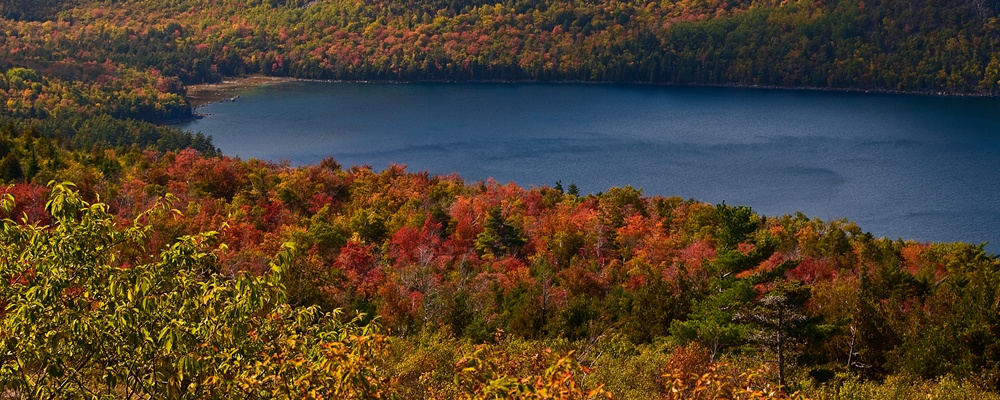

Acadia National Park is the only United States National Park in New England. It is on the coast of the Down East region of Maine, near the town of Bar Harbor.
Understand
Acadia NP encompasses more than 47,000 acres, 30,300 of which are on Mount Desert Island. 2,728 acres of the park lie on Isle au Haut and 2,266 more on Schoodic Peninsula.
Acadia is one of the smaller national parks in the country, yet it attracts nearly 3 million visitors per year. It is important that those who do visit and explore this wonderful park follow some basic guidelines in order to keep the park as clean, natural, and undisturbed as possible. Please review the Leave No Trace principles if you're planning a trip, and remember them while you are having a great vacation. Help keep Acadia the way it should be. Friends of Acadia is a group that offers additional details about respecting this natural wonder.
History
Originally designated as Sieur de Monts National Monument in 1916 by presidential proclamation, Congress renamed the park Lafayette National Park in 1919. Congress again enacted a name change in 1929 to the name we now use, Acadia National Park. It was the first NP established east of the Mississippi River.
In October 1947 Acadia, along with some adjacent lands, was ravaged by fire.
Climate
Acadia's weather is largely a product of latitude and marine influences. On a daily and annual basis, Mount Desert Island temperatures are more moderate than those of inland Maine. The Maine coastal climate has been ranked second only to the Pacific Northwest in annual precipitation. This moisture occurs in every form at Acadia. Ice storms are regular in winter and early spring, and rain is frequent in every month. Fog is common during June, July, and August.
Spring can be foggy with temperatures ranging between 30 and 70 degrees F. Wear light-colored clothing, long sleeve shirts, and long pants for protection. Annual rainfall is 48 inches.
Summer daytime temperatures range from 45 to 90 degrees F. Evenings are cooler. Dressing in layers is advisable for any boating or hiking activities. Ocean water temperatures range from 50 to 60 degrees F. Lake water temperatures range from 55 to 70 degrees F.
Fall temperatures can range from low 70s during the day to freezing during the night. Come prepared for all types of weather, from sun to fog, from downpours to flurries. Fall foliage often peaks during the first couple of weeks in October. Weather conditions over the summer, such as drought, may alter the time that the leaves peak.
In the winter, due to Acadia's coastal location, snow and weather conditions change rapidly. Temperatures vary from mid-30s to below zero. The park averages 61 inches of snow annually. For the latest in weather information, call the local weather phone line at 207-667-8910 or call the park at 207-288-3338.
Landscape
A quick look at any topographical map of Mount Desert Island will indicate the powerful and lasting effects of the last ice age on the island and the current landscape of Acadia. As the last glacier receded over 18,000 years ago it left behind the elongated mountains and lakes we see today. The moving ice was also the culprit behind the "bald" summits of most of the park's hilltops, scraping off vegetation and leaving the beautiful pink granite underneath.
Flora and fauna
More than 273 bird species have been identified in the park, including bald eagles, peregrine falcons, blue jays, finches, and chickadees (the Maine state bird). Mammal species include deer, squirrels, foxes, rabbits, porcupines and bats. Other species include garter snakes, the American bullfrog, and the North American red-bellied salamander.
The National Park's checklist of common plants can be found here
Getting there
Acadia National Park is located along the rugged, rocky coast of "Downeast" Maine. Most of the park is located on Mount Desert Island, which is accessible by vehicle. The park is approximately six hours north of Boston.
By Car
From Boston take I-95 north to Augusta, Maine, then Route 3 east to Ellsworth and on to Mount Desert Island. For an alternate route, continue on I-95 north to Bangor, Maine, then take Route 1A east to Ellsworth. In Ellsworth, take Route 3 to Mount Desert Island.
Distances from Other Cities
Bangor, ME 50 miles, 1 hour
Portland, ME 161 miles, 3.5 hours
Kittery, ME 211 miles, 4.5 hours
Boston, MA 264 miles, 6 hours
New York, NY 492 miles, 10 hours
Saint John, New Brunswick 227 miles, 5 hours
Montreal, Quebec 424 miles, 8 hours
Halifax, Nova Scotia 500 miles, 10 hours
By plane
Direct flights from Boston's Logan Airport land at the Hancock County Airport, located 10 miles from Acadia National Park. National airlines serve the Bangor International Airport, about one hour from the park. Car rentals are available at both airports.
By ferry
A ferry to Nova Scotia sails between Bar Harbor, Maine and Yarmouth, Nova Scotia. Schedules vary depending on the season. Phone (888) 249-SAIL or (207) 288-3395.
Traveling around
The free Island Explorer bus system, Phone: +1 207 667-5796, can take you through the park, stopping at points of interest. There are bicycle racks on the front and back of each bus if you'd like to combine transport methods as you explore. Island Explorer buses are propane powered.
See
Things to do
Bicycling
There is an extensive network of carriage roads throughout Acadia National Park, which are closed to automobiles and are excellent places to ride your bicycle. The carriage roads are mostly paved with crushed stone and, therefore, are best navigated on a mountain or hybrid bicycle. Another option for cyclists is the ~20 mile long Park Loop Road, which encircles much of the eastern portion of the park. The road is open to automobiles, but is a one-way, two-lane road for much of it's length. Cyclists will be happy to note that the Park Loop Road appears to have been recently re-paved (as of August 2008), making for a very smooth, pleasant ride. Bikes can be rented in Bar Harbor.
Bird watching
Acadia is a great place to birdwatch, with many species calling the park home. Bald eagles, peregrine falcons, great blue herons, cranes, ducks, geese, chickadees, woodpeckers, owls, orioles and blue jays can be seen in the park, just to name a few of the most common. For an extensive checklist and more info on birdwatching opportunities in Acadia, see the NPS's birdwatching page here
Carriages
Fishing
Acadia National Park's site on regulations, species, etc.
While ocean fishing is open to all, fishing in freshwater lakes and ponds requires a Maine state fishing license. Licenses are required for residents 16 and up and non-residents 12 and up, and can be purchased at town offices and a few local shops.
Hiking
Acadia has the best day hiking in the Eastern U.S. Walking the is one of the best ways to experience the park. Immerse yourself in the flora and fauna of the island on a number of different hikes of various environment, length, and difficulty. These trails are stunning, with high ocean views, accessible tree lines, steep precipices, stone bridges, etc.
Paddling
The last glacier of 18,000 years ago carved out the incredible and beautiful terrain of the park, leaving behind some of the cleanest lakes and ponds in the country. Sea kayaking tours and boat rental services are offered from numerous establishments in Bar Harbor and allow access to Mount Desert Island and other destinations.
Nature Tours
Swimming
Some ponds and lakes are used for drinking water. Check park office for list of approved swimming locations.
Sand Beach
Echo Lake beach
Eat
Sleep
Camping
Mount Desert Island
Blackwoods Campground, Phone: +1 800 365-2267 (reservations), . Open year-round. Reservations are required from mid-June - mid-Sept. 306 sites, no hookup. $20.
Seawall Campground, Phone: +1 800 365-2267, . Open mid May - Sept. Reservations are not accepted; Seawall is first-come, first-served. 214 sites. $20 drive in, $14 walk-in tent. Isle Au Haut
Primitive camping is available on Isle au Haut. Reservations are recommended well in advance, but are not accepted before April 1st.
Access to Isle au Haut is via limited passenger ferry service; Confirm boat schedule with Isle au Haut Ferry Company, (207) 367-6516, before reserving a campsite. Campers should be prepared to hike five miles to reach camp from Town Landing, if the ferry is not scheduled to continue on to Duck Harbor on date of arrival.
Stays are a maximum of 3 or 5 days, depending on season. Campsites have lean-tos and pit toilets; tents may be erected inside lean-tos only.
Backcountry
Apart from the campgrounds, those looking to see the 'real' Maine can look into more adventurous places to sleep. The Park is full of locations where one can set up a pup tent for the night, although it is advised to do so at discretion, pack light, and leave no trace.
Officially, backcountry camping is not permitted (and strongly discouraged due to the fragile ecosystem) in Acadia National Park.
Safety
If you are determined to go out on your own, it would be foolish and could result in serious fines from the Coast Guard or a Marine Patrol officer to do so without every single passenger:
wearing a PFD and/or
having a compass and knowing how to use it and/or
understanding how to navigate safely around other boats and water hazards
There are numerous companies on Mount Desert Island and elsewhere that offer guided sea kayak, sailing, and power boat tours.
Fees/Permits
There are:
7-day (vehicle) entrance permit, $20 in-season, $10 off-season
7-day individual park pass, $5
Annual Acadia pass, $40
Commercial mini bus (capacity 16-25), $60 for 1 entrance
Commercial sedan (capacity 1-6), $25 + $5/visitor for 1 entrance
Commercial tour bus (capacity 26+), $150 for 1 entrance
Commercial van (capacity 7-15), $50 for 1 entrance
Contact & location
Be the first one to add a review
The photos displayed on this page are the property of one of the following authors:
solarnu, InAweofGod'sCreation, Liza, Natale Carioni, Tony, woodley wonderworks, David Goehring, Marcus, Richard Wood, Surabhi Dhake
Some photos courtesy of: . The photos provided by Flickr are under the copyright of their owners.
This travel guide also includes text from Wikitravel articles, all available at View full credits
Ryan Holliday, John Potelle, Peter Fitzgerald, Eric Polk, David, Andrew Haggard, Patrick McDonald, Todd VerBeek, Jim Logan and Derek M. Strout, Brescian, Baileypalblue, Zandperl and Huttite
This travel guide also includes text from Wikipedia articles, all available at View full credits