Christmas Island - Red Crab Migration
( 1 user review )Understand
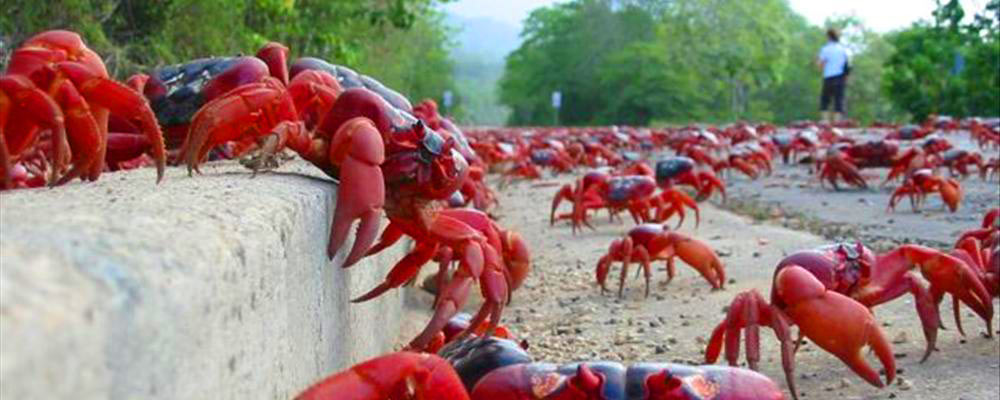
Christmas Island sees a major spectacle every year, around the beginning of the wet season (usually October / November). 100 million red crabs of Christmas Island begin their march, leaving the forests, heading towards the coast driven by the basic instinct: to reproduce.
Tides of red carapaces, enough to be seen from the air, suddenly begin a spectacular migration from the forest to the coast, to breed and release eggs into the sea. The rainy seasons offers the right humid conditions for crabs to make their long and difficult journey to the sea.
Watch an amazing video of the migration http://www.youtube.com/watch?v=yvabv7a6m7E
When to go & Weather
The timing of this event is linked to both the rainy season and the phases of the moon.
The migration, dipping, mating, and egg-brooding sequences take place before the females spawn. All these events occur in the 4 weeks preceding spawning, and one cannot pinpoint the precise date of the beginning of the migration before spawning.
Some believe the phases of the moon also affect the timing of the migration, so that eggs may be released by the female Red Crabs into the sea precisely at the turn of the high tide during the last quarter of the moon. It is thought that this occurs at this time because there is the least difference between high and low tides. The level of the sea at the base of the coast and on the beaches varies the least and this means it is safer for the females approaching the water to release their eggs. All migrations are timed with the same lunar rhythm, even if they occur earlier or later.
How long does it last?
The main migration can last up to 18 days. Tides or "streams" of thousands of crabs move towards the coast, crawling over all obstacles in their way, negociating the same precise route used the previous year for both the "outbound" and "return" journeys. The crabs must not be caught for long in open areas where it's hot, because the heat causes them to loose water and die. They're quite smart little buggers, so the top moving period is in the early moist mornings and late afternoons when the shade protects them and the temperature is lower.
Impact of Humans
Many crabs perish during the migration due to the impact of human activity, in particular by drivers..
The island has worked hard in coming up with measures to reduce the number of crabs killed every year: Road signs, Barriers, Road closures, Underground tunnels, Diverted traffic and a variety of "crab crossings" have all been introduced in the recent years.
please contact the Christmas Island Tourism Association for the latest updates http://www.christmas.net.au
Contact & location
1 Review

Add your review
The photos displayed on this page are the property of one of the following authors:
Di Masters
This travel guide also includes text from Wikitravel articles, all available at  View full credits
This travel guide also includes text from Wikipedia articles, all available at  View full credits
People who'd like to go there (3)



I liked
It's amazing. I didn't knew this.I disliked
Nothing