Salvador is the capital of the state of Bahia, Brazil. With a charming Old Town (a World Heritage Site), a vibrant musical scene and popular Carnival celebrations, it is considered one of the birthplaces of Brazilian culture.
Understand
History
Founded in 1549, Salvador was the capital in the heyday of the slave trade. The legacy remains today in its large black population, and the resulting culture in many ways outshines the rest of Brazil; in music, many of the greatest names from the mid-20th century to the present hail from Salvador, such as Dorival Caymmi, Gilberto Gil, and Caetano Veloso. In literature, the late Jorge Amado was also from the region. It's a vibrant, exciting city, and its people are quite friendly.
Orientation
Salvador is on a peninsula on the northeast coast of brazil which shields the large Baía de Todos os Santos ("Bay of All Saints") from the Atlantic Ocean. The city is the third largest in Brazil, sprawling for dozens of kilometers inland from the coast. Most visitors head for the coastal neighborhoods that cluster around where the bay meets the ocean.Salvador, Brazil has a tropical climate including rainforests and lush vegetation.
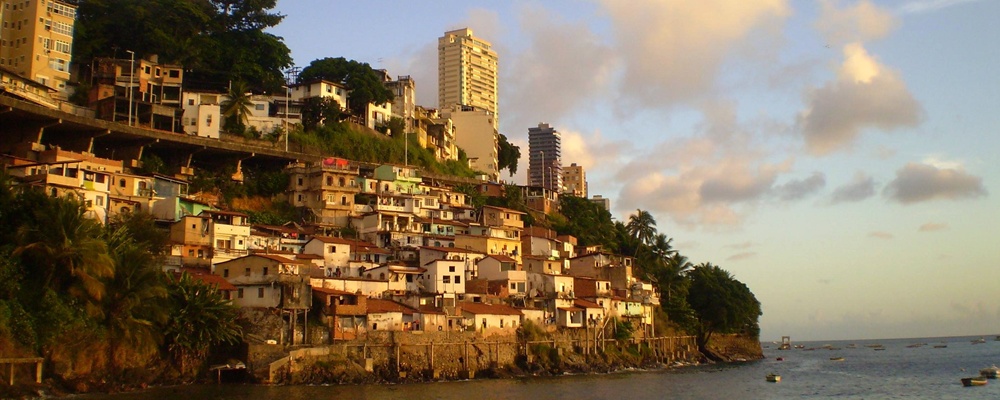
A 100m cliff runs along the entire bayshore, dividing the city into Cidade Alta, up on the cliff, and the Cidade Baixa down by the bay. The former features Pelourinho, the old city center that packs historical sites, colonial architecture, museums, restaurants, bars, hostels, artisanal shops, and music/dance/capoeira academies into a convenient, albeit tourist-swarmed, set of winding cobblestone streets. The latter features a commercial center with lots of bus traffic coming in from all over Salvador.
Outside of this area, there are many beach districts that stretch from the tip of the peninsula northeast along the Atlantic coast. The Barra neighborhood at the tip of the peninsula is the main alternative jumping-off point to Pelourinho, and a little further to the northeast are the hip neighborhoods of Rio Vermelho and Amaralina, which feature a nightlife less geared to the foreign tourism industry. A decent bus ride beyond these is the neighborhood of Itapuã, which has an energetic beach side nightlife and relatively few foreign visitors. Northward from there are kilometers and kilometers of gorgeous beaches, all accessible by bus.
The bayshore coast north beyond Pelourinho features a more tranquil atmosphere and a locally patronized, though less scenic, beach life. The interior of Salvador is where the "new city" has developed, full of residential neighborhoods, shopping megaplexes, and knotted highways, all of which can be quite alienating without actually having a friend to show you around.
Local residents enjoy sharing their exotic dancing and music skills with tourists. Residents are also considered some of the friendliest people on the planet.Tourist are welcomed with open and friendly arms by the majority of local residents.
People
People of Salvador, as other people from the state of Bahia, have a reputation of being relaxed, easygoing, and fun-loving, even for brazillian standards. On the bad side, this is also interpreted as lazyness and disgust of working; in a way, people of Salvador have reputation opposite to people from São Paulo. It's questionable whether this reputation is true, as the behavior of pedestrians and drivers in traffic seems to contradict this. Regardless, few soteropolitanos seem to bother with this reputation, even the bad part of it, and some even make fun of their own supposed lazyness. Also, most people in Brazil agree that soteropolitanos are generally friendly and warm people.
Brazil is a country of social unequality, but on few places this is as evident as on Salvador. The social segregation is also evident, with large number of upper middle class and upper class citizens living in gated communities, which contrast with the huge slum-like neighborhoods located on elevated areas. This unequality is also reflected on skin color, with most of rich people being white and most of poor people being black.
Getting there
By plane
The Salvador's Deputado Luis Eduardo Magalhães International Airport (IATA: SSA, ICAO: SBSV) is one of Brazil's main airports. All of the biggest Brazilian airlines have flights to the Bahian capital city. The city also receives flights from the main hubs of Europe, South America and the United States.
The airport is 28km from the city center (via the Paralela expressway) or 32km (via the seaside). Two kinds of taxis are available in the airport, the executive taxis (Coometas and Comtas), and the normal taxis. Executive taxis are pre-paid, they have a table of prices rather than a meters. The other taxi option would be the normal taxis which are metered. A third option would be the executive air-conditionedminibuses which depart every 20 minutes to the Praça da Sé, in downtown near Pelourinho via the seaside, stopping at famous beaches like Ondina, Pituba, Amaralina and Itapuã, and Barra as well as stopping by Shopping Barra--an American-style shopping mall located not too far from the Farol da Barra The fare for these buses is R$4. Another option is the urban buses that go to many parts of the city, for the tourist the options are Lapa, Campo Grande and São Joaquim buses, the best thing is ask the driver before taking an urban bus, the fare is R$2,30 (2 reals and 30 centavos). Linha Verde executive buses go to Praia do Forte and depart often from the airport.
By bus
Salvador's long-distance bus station is in the middle of the new city, 14km from downtown. Salvador is accessible via scheduled buses from all around the country and from Paraguay. Inside the bus stations there are taxis (local taxis and executive taxis) and local buses which can all take you to many places in Salvador and the metropolitan area. Executive buses in the Iguatemi Station can be accessed from the Iguatemi Mall by way of a busy walkway. Bus travel in and out of Salvador can take a lot more time than expected. Count on an average speed of 50-60 km/h when planning your itinerary.
By boat
Salvador is a common stop on international cruise routes and was once visited by the Queen Elizabeth 2 during her sailing career. Note that the docks area can be dangerous. This area is linked to the Pelourinho historic centre by the Elevador Lacerda, and to the city by urban buses and executive buses to Iguatemi.
Traveling around
By foot
There are a number of transportation options available in Salvador, including taxix, buses and car rentals. the bus fares are quite affordable, although the taxi fares can be quite expensive if one id traveling a long distance.
The old city center can be easily explored on foot. To get between the upper and lower sections, take the Elevador Lacerda or the cable car, remember to take small change as the fare is just R$0.15. The streets between the two are considered dangerous even during the day.
By bus
City buses, as in other Brazilian cities, are constant and confusing. Fares are normally R$2.30 (even for buses into the neighboring city of Lauro de Freitas). There is also the option of the air-conditioned executive buses for R$4. Remember to board in the back for the full-sized buses.
Know your landmarks and neighborhood names. Any large shopping area will have a complimentary frequented bus stop, and the major intercity terminal, Lapa, is next to Shopping Lapa.
Other major bus terminals include: Estação Iguatemi (between the Rodoviaria and Shopping Iguatemi), and Estação Mussurunga (located on the Paralela with buses usually connecting to Praia do Flamengo interior neighborhoods in Salvador).
If you are trying to make your way out of Pelourinho, you can either take the Elevador Lacerda down to the Comercio and find buses for just about every route, or walk to the Praca da Sé bus stop just south of the elevator, which has a much smaller selection of buses passing through, and many options of executive buses.
Buses are safe to ride at night, as long as you are on a frequented (i.e. coastal) route and dress/act inconspicuously. Service stops at midnight and begins again around 4:30-5AM. There are a limited number of lines that provide night service from midnight-4AM.
You can find more about about the Salvador bus routes and time tables one the website for the Superintendência de Transporte Público (in Portuguese only).
By taxi
Salvador cab drivers must be competing with those in Rio for spots on Formula 1 racing teams. They will certainly get you where you're going quicker than the bus! However, as buses stop running after midnight, do be prepared to haggle quite a bit with taxistas who refuse to use the meter, especially if you've decided to explore far from your bed. Executive taxis (white and blue) don't have meters, and the prices are on a table, it's more expensive than city taxis, but they are much more comfortable, they are in stops in the main shopping malls, the airport, bus station, ferry-boat station and big hotels.
By car
Renting a basic car with air conditioning (100+ kilometers or KM free) costs R$ 110-140 per day, plus fuel. It's not hard to find your way accross Salvador avenues, but although people from Bahia have a reputation of being relaxed and easygoing, traffic is agressive (somewhat like Rio de Janeiro), and you will frequently see drivers attempting dangerous overtakes on you. Pedestrians are also careless and unexpectely run to cross roads and streets. If you are not used to this type of traffic, consider asking for a private driver, which is possible on many car renting agencies. Renting a car may be a good idea if you plan to visit the beaches from the northern part of Bahia, with more time flexibility than allowed by travel agencies.
By bicycle
Cycling is not really a good option to get around in Salvador, as there aren't enough cycleways and parking for bicycles, and drivers don't have any respect for cyclists. An exception is the cycleway in the east coast of Salvador, which has 12,55 km and goes from Amaralina to Piatã beaches. Be aware that as the cycleway is not very used, a lot of pedestrians use it for walking.
See
At the center of the Cidade Alta there are the two large squares Praça da Sé and the Terreiro de Jesus which are connected at the corner by the cathedral. The latter is probably the most lively part of town, with food carts and stalls through the day and revelers in the evening hours.
Museu Afro-Brasileiro, M-F 9AM-6PM, Sa Su 10AM-5PM, — A museum that documents the slave trade and subsequent development of the city.
Largo do Pelourinho — A fairly small triangular plaza, is among the oldest parts of town. You can guess from its name meaning "plaza of the pillory" what went on around there.
Mercado Modelo — The city's main market located in the lower town is and a good place for crafts and other souvenirs. In the adjacent square you can often see young men performing capoeira, the famous martial arts dance which originates from the area.
Igreja do Nosso Senhor do Bonfim — A small church located in a neighborhood to the north, is one of the most popular pilgrimage sites in all of Brazil. The colorful votive ribbons or fitas of Bonfim are an easily recognizable item throughout Brazil and even beyond. Children outside the church will (for a small fee) tie them around your wrist and tell you to make a wish for each one. If the ribbon wears off naturally, the wish will come true; if you cut it off before then, it won't. You can get to Bonfim by city bus in about fifteen minutes.
Abaeté Park — A protected state park around the lake with same name. The lake is famous because of the stark contrast between the dark water and the very white sand dunes. There is a entertainment area with a lot of bars and live music.
Solar do Unhão — The best place in Salvador to watch the sunset. It is an old style house located at the **Baía de Todos os Santos. Inside there is a small museum (Museu de Arte Moderna) with local art pieces. Sometimes on Saturday evening there is a jazz concert.
Things to do
You'll find a huge variety of things to do in Salvador Brazil. Some of the popular activities include:
-Day tour of Salvador
-Salvador Parks
-Salvador golf courses
-Salvador music festivals
-Surf trips
A good brazil tour guide in Salvador, known as a guia de Salvador, will be able to show you around lots of the attractions and activities. If you want to explore on your own , you could choose to spend the day at Salvador Brazil Iberapuera park. It is huge and sometimes called the "lung of Sao Paulo" because of the greenery. There are always free concerts on the weekends and is often very busy with locals biking, jogging or hanging out.
One of the main attractions in Salvador is the carnaval. *Salvador's giant Carnival, the biggest of the world, according to the Guiness book of records, lasts for one week and is extremely popular with Brazilians and tourists alike. The event happens at the first of the year and consists of parades,l entertainment, music, dancers and vendors. One can expect to have a lot of fun if they vacation in Salvador, Brazil during Carnival.Salvador also has many other attractions that tourists will find enjoyable. these include golf courses, museums and even an old 17th century fort. Anyone wishing to visit Salvador Brazil will find their trip to be entertaining, fun and full of wonderful memories.
Go to the beach
Visiting a Salvador brazil beach is a highlight for many tourists. One of the main central Salvador beaches is Porto de Barra. It was orginally the site of the first settlement of european newcomers to Bahia. It can get very crowded on weekends. The northeast region of Salvador concentrates most beaches with good water quality. Flamengo and Stella Maris are the most popular beaches among tourists and upper class locals. They have excellent tourist infrastructure and rough waters excellent for surfing. Jaguaribe, Piatã and Itapoã, with calmer waters, are mostly frequented by locals and can become quite crowded at weekends. They are a good option with you want to mix with the local population, but don't bring anything besides your clothes, sunglasses, sunscreen, and some cash, as muggings are quite common.
The other beaches of Salvador aren't suited for bathing, but still can be good for walking, cycling, or taking pictures. Farol da Barra has a beautiful view (specially during the sunset), but it's difficult to walk due to the rocks. "Farol" means lighthouse, and this beach is known for its lighthouse as well as being popular with surfers. A much safer choice is nearby Plakaford. Here the calm waters and soft sandy beaches are welcoming for families and children. In the city south, there is an array of beautiful beaches that include Tinhare and Boipeba.
Eat
Bahian restaurants are considered to be among the best in brazil. The majority of bahia restaurants offer South American cuisine but there a few that offer other specialties. For example, the Maria Mato Mouro located at Rua 3A Ordem de Sao Francisco, Pelourinho serves a wide range of seafood dishes from all over the world although most are from south america. One of the most popular dishes is the grilled bahia fish badejo. this restaurant is open daily from noon until 1am and offers main courses from $15 to $25. The Terreiro de Jesus is a great place to sample the local cuisine from street stalls, served by Afro-Brazilian baianas in their traditional white dresses. A must try dish is the Abara. This is a wrap with bean paste, dende oil and onions all cooked in a banana leaf with spices for flavour. if you prefer western food then you will find many fast-food places like Burger King, McDonald's, Subway or Pizza Hut. You also will find casual dinner chains like Outback Steakhouse.
Be sure to try acarajé, small fritters made from black-eyed peas and onions fried in palm oil slathered with spicy vatapá (shrimp paste).These are sold by Baianas on the street.
Here are a list of restuarants to try:
Budget
Acarajé da Cira, Largo de Itapuã, 3249-4170. Fresh acarajé daily from 10AM-11PM. There is also another location on the Largo da Mariquita in Rio Vermelho.
Acarajé da Dica, Rua J, Castro Rabelo, Pelourinho. Open T-Sa 3PM-11PM, Su 10AM-1AM.
Health Valley Brasil (closed until Jan/03/2010 for renovations), Rua Direita da Piedade (in the city center). Vegetarian restaurant run by an African couple. Serving typical dishes based around ginger. Very popular with the local alternative crowd. Buffet including fruit juice and desert costs R$8.
Quiosque de Amaralina, Ave Otávio Mangabeira, Amaralina. Serving acarajé near the beach from 4PM to midnight.
Mid-range
Bistrô PortoSol, (on a cross-street near Porto da Barra). Small, cozy Austrian-Hungarian restaurant run by an Austrian and his wife. Simple accommodations decorated with posters of classic Hollywood movies. Quite delicious.
Companhia da Pizza, Rio Vermelho (on a cross-street near the Pestana Bahia and Blue Tree Towers hotels). One of the city's most popular pizza restaurants.
La Figa, Rua das Laranjeiras 17, Pelourinho (near Terreiro de Jesus). Italian restaurant with fresh pastas around R$35 for two people, appetizers around R$10, and deserts. The new owner changed the name in June 2007 (It was previously known as La Lupa), but the high quality, good service and good atmosphere remain the same.
Maria Mata Mouro, Pelourinho (near São Francisco church). Small, with only twelve tables but the service is great. Try the shrimp.
Meridiano, Ave Tancredo Neves (in front of the Casa do Comércio building). Gourmet cuisine at moderate prices. Excellent service.
São Salvador, (on the grounds of the Salvador Trade Center). Buffet with a refined atmosphere.
Sankofa African Bar e Restaurante, Pelourinho, Rua Frei Vicente, 7. African food and drinks with exotic flavors at very reasonable prices. Less than $R15 per person including one drink.
Hostel galeria 13, Pelourinho, Rua da ordem terceira no 23.The new european owner offers Pelourinho a much needed variety of international dishes & spanish tapas.The menu includes a great selection of vegetarian meals from around the world.You can enjoy your meal in the unique morrocan chill out room or in their patio garden.They also offer those great juices with a touch of ginger 'refreshing',or maybe a caipirinha with water melon.The quanties are very generous an the prices are extremely fair.
Splurge
Amado, Ave Contorno. Contemporary cuisine.
Barbacoa, Ave Tancredo Neves. Fine meat dishes and some of Salvador's best feijoada in a refined atmosphere.
Boi Preto, Boca do Rio (in front of Aeroclube Plaza Show near the Convention Center). One of the best churrascarias in town. Full buffet and salad bar plus unlimited fine cuts of meat.
Casa do Comércio, Ave Tancredo Neves, 11F (in the heart of the financial district). A good place to eat well and take in a panoramic view of Salvador.
Marc Le Dantec, Pier Sul Apartment Service, Ondina. The best French restaurant in the city.
Mistura, Itapoã. Specializing in fish and international cuisine.
Trapiche Adelaide, Comércia. Voted among the best fine dining in the city, with a fine view of the Bay of All-Saints.
Yemanjá, Ave Otávio Mangabeira 9292, Pitubá, 231-5570. Long held nationally and internationally as the standard in typical Bahian cuisine.
No trip to a Salvador restaurant is complete without dessert. The Bahia region is famed for it's sweet tooth. A Cubana located at Rua Alfredo de Brito 12 is open daily from 8am until 10pm. It is an old fashioned ice0cream parlor or sorvetoria with 28 homemade flavors.
Drink
Bars
Bar da Ponta, beside the Trapiche Adelaide. A place to see and be seen, drink, and have a fantastic view of the bay.
Beco dos Artistas, near Campo Grande. One of the gay and lesbian areas of the city, with a diversified crowd. Friday and Saturday nights only. The area has various bars and a restaurant (the nightclub is now closed). Aim to get there around 10PM, as it starts to empty around midnight as people move onto other clubs.
Bohemia Music Bar, Jardim Brasil. The comfortable atmosphere, live music, and a varied menu make this a popular pick-up spot. The places often checks for IDs at the entrance.
Chuleta, Vale do Canela (near the UFB campus and the neighborhoods of Graça and Vitória). Boteco frequented by university students, famous for its cheap beer and for the meat snack from which the bar takes its name. Open air, plastic tables.
Largo de Santana, Rio Vermelho. This busy street has various bars and restaurants, and some of the best acarajé in town.
Mercado do Peixe, Rio Vermelho (at the seaside in front of the Blue Tree Towers Hotel). One of the best after-hours spots, Mercado do Peixe is a real Salvador institution. It starts to get busy after 3AM when everywhere else is closing. With simple accommodations and plastic tables, various stands stay open offering moquecas and regional appetizers, in addition to drinks. During the day it is, as its name suggests, a traditional seafood market.
Sankofa African Bar e Restaurante, Rua Frei Vicente, No 7, Pelourinho, . In the middle of the Pelourinho. Live bands (salsa, samba, reggae, zouk, semba) and DJ's spinning African, Brasilian and world music. Tasty African dishes and drinks are also offered. African flags, maps, and artworks adorn the walls. The top floor has a projection system showing films and documentaries.
Hostel Galeria 13, Pelourinho, Rua da ordem terceira no 23.The new native English speaking owner has travelled & worked in many famous bars & clubs around the world you will get a chance to check out his knowledge of drinks.They offer great juices with a touch of ginger 'refreshing',or maybe a caipirinha or roska with water melon already being boasted the best in Brasil,a big Claim take him up on it.You can enjoy your drinks in the garden or the most original spot in Pelourinho,the Morrocan "chill out" room.
Bar Zulu,Pelourinho,Rua das laranjeiras no 15. tel 87843172.A very international bar & vegetarian restaurant.A mix of staff from all over the world bring you a cool corner bar with terrace & individual bar tables in every window,great for people watching.The bar offers the most original menu in The "Pelo",spanish tapas,salads,sandwiches ,international dishes & a vast choice of great veggie dishes from around the world.The bar has a feel of a trendy spanish tapas bar with some of the friendliest girls serving with a smile.Try there house special Caipirinha "zumarangi"strawberry & passion fruit.The owner promises they will soon be providing a sports tv,so a great spot for catching european footie
Nightclubs
Dolce, on the first floor of Shopping Boulevard 161, Itaigara. Very busy club, attracting a somewhat older crowd.
Fashion Club, Ave Octávio Mangabeira, 2.471, Pituba, 71 3346 0012. Once the most vibrant nightclub in Salvador, Fashion Club has taken somewhat of a backseat since the opening of Lotus. Prices, however, are around half of what you would pay at Lotus.
Lotus — Often mentioned in tourist guides but now closed.
Off Clube, Rua Dias Dávila, 33, Barra, 71 3267 6215. The main gay and lesbian club in town. A variety of events attracts locals of all social classes.
Rock in Rio Café — Often mentioned in tourist guides but now closed.
Zauber Multicultura, Ladeira da Misericórdia, 11, Edifício Taveira, Comércio, 71 3326 2964. Combining music and visual arts in one of the most important historic areas of the city. The space bridges between the old (architecture) and the new (decoration). Find out what is going on before you go, and take a taxi, as the location is in a rather dangerous and prostitution-plagued area of the city.
Sleep
There are a number of hotles in Salvador brazil that tourists can stay in when on vacation. Some of the hotels are luxury hotels located on the beach. Salvador also has discount hotels that offer cheap rates for those on a budget. Some of the cheap hotels may not offer all of the amenities that luxury hotles offer. There are also hostels in Pelourinho that are reasonably priced, but noisy at night.
Sao Jorge, in Pelourinho, . Charges R$50 a night for a double room (May 2006).
Hotel Cocoon, rua Haeckel José de Almeida, 46, Jaguaribe, . Very nice hotel with interesting architecture. The receptionists speak fluent English, and there is free internet access. Just meters away from the beach, 5-6 minutes from the Conventions Center or shops at Iguatemi, and 25 minutes away from historic Pelourinho. There is a bus stop close to the hotel on the main road along the beach, so it is easy to reach Pelourinho from the hotel without using a taxi.
Budget
A Meson Pousada, Rua Portas do Carmo 11 , Pelourinho 51 (71) 3322-8039 offers affordable lodging in the middle of all the action , both day and night, for Salvador's Historic District .
Open House, Rua Comendador Bernado Catarino, 137, Barra, +55 11 3711-2186 - run by an artist couple, Cuban writer and film director husband Alex and Brasillian painter, dancer and choreographer wife Jacqui. A few blocks from Barra beach and trendy restaurants and bars, the house is full of paintings and artistic touch and incredible hospitality. Dorm and private rooms available. .
Ibis Salvador Rio Vermelho, Rua Fonte do Boi, 215, Rio Vermelho, (71) 3172-4100, .
Hotel Ondimar, Ave Oceânica, 1843, Ondina, (71) 3339-8383, .
Sol Plaza Sleep, Ave Otávio Mangabeira, 4581, Praia de Armação, (71) 3418-3699, .
Praia da Sereia, Ave Dorival Caymmi, 14, Itapoã (near the airport), (71) 3285-8100, .
There are 3 hostels affiliated with Hostelling International, two situated in Barra and one in Pelourinho. All are quality youth hostels.
Albergue do Porto, Rua Barão de Sergy, 197/207, Barra +(71) 264-6600, .
Hostel Barra, Rua Artur Neiva, 04, Barra, (near Morro do Cristo). +(55)71-3245-2600, .
Laranjeiras Hostel, Rua da Ordem Terceira 13, Pelourinho, (071)3321-1366, .
Hostel Galeria13, Rua da ordem terceira 23, Pelourinho, 71-32665609, .
Mid-range
Bahia Othon Palace Hotel is located on av. Oceanica 2294 Ondina in Salvador Bahia. The hotel faces Ondian Beach and provides guest with a magnificicant view of the Atlanitc Ocean. The hotel offers a nightclub, beauty spa and other activities. Rates start at $103 per night.
Vila Galé Salvador, 351 217 9076190, 351 217 9076190, Ave Rua Morro Escravo Miguel, 320 Ondina CEP 41
700.000 Salvador Bahia - Brasil, Located right on Praia de Ondina in São Salvador da Bahia and only 20 minute away from the International Airport. Online booking.
Mercure Salvador Rio Vermelho, Rua Fonte do Boi, 215, Rio Vermelho, (71) 3172-4100, (Fax:713172 9201), .
Iguatemi Business Flat, Rua das Alfazemas, 761, Caminho das Árvores, 71 2101-1300 .
Hotel Redfish, Ladeira do Boqueirão, N°1 Santo Antonio/Centro Histórico, . A boutique hotel in Pelourinho that will please those looking for a hotel within walking distance of the local attractions. The 'luxury' rooms are spacious with high ceilings that easily accommodate two king-sized beds. A traditional hammock is available for use on the large balcony that overlooks the harbour. The luxury rooms are value for money but do not have the luxury-extras such as a TV or a full-range of toiletries. The breakfast-room overlooks a high school and guests will leave with a clear idea of what happens in a Brazilian school.
Splurge
Vila Galé Salvador, Ondina, 0800 2848818, (reservas.ssa@vilagale.com.br), . 5-star hotel located right on the seaside, close to tourist attractions.
Fiesta bahia Hotel located at Avenida Antonio Carlos Magalhes 711 in Salvador Brazil. The hotel provides a convention center for businesses and a floor just for ladies has been disgned with feminine needs in mind. a gym, game room, wet and dry sauna, spa and outdoor pool are just a few of the services provided for guest. Rates start at $210. per night for luxury rooms and $468 per night for suites.
Buy
Salvador shopping is the bargain hunters paradise. There is nothing that you cannot find in a mall. If you plan to buy popular art, crafts and clothing, check the small stores at the Old Town or head to the Mercado Modelo (Model Market).
Locals like to shop at American-style shopping malls.
Shopping Center Iguatemi
Salvador Shopping
Shopping Barra
Shopping Itaigara
Shopping Center Lapa
Shopping Piedade
Bahia Outlet Center
'''Aeroclube Shopping & Office'
The first thing that anyone wanting to shop in Salvador should know is that it is essential to barter. very few vendors will stick to their given price. If pushed they will always go lower. If you are looking for souvenirs you may want to check out Litoral Norte located at Rua Gregorio de Matos 30. They sell tshirts and other items. Most will cost you no more than $5.
If you want local art you should visit Pelourhino. There are many galleries that double as stores. Galeria 13 at Rua Santa Isabel 13 displays work by local artists.
Safety
Due to high social inequality, Salvador is notorious for street crime, and for a tourist the likelihood of a mugging or armed robbery is considerably higher than in São Paulo and perhaps even Rio de Janeiro.
People with darker complexions will have an advantage over those with pale skin. Blacks are likely to blend in well; other dark-skinned people may be inconspicuous in many places, but whites and asians are immediately labelled as either upper class citizens or tourists, and may be specially targeted.
If you are moving on foot, by bicycle, or by bus, it's best to go out during the day. Avoid bringing anything valuable, just enough to enjoy your day. The Flamengo and Stella Maris beaches are among the safest places to go during the day, and they are the best option if you just want to enjoy a good beach without much local culture.
In other places, when walking on the streets and on the beach, try to stay at areas guarded by police. Salvador recognizes the importance of tourism to the city economy, so most important tourist sites such as Pelourinho and Mercado Modelo, as well as main popular festivals like the Carnival, are usually heavily guarded. Walking in groups is usually preferable; if you are alone, consider booking a guided tour with your hotel.
As a general rule, be suspicious if people approach you directly in a friendly way as they either want money or to sell you something.
At night, it's better to move by cab. Stay at reasonably crowded places. If you don't see other tourists where you are, then it's probably not a place you should be unless you are feeling particularly adventurous.
Some areas, which are strongly frequented by foreigners, can become dangerous, especially at night, i.e. the Barra harbour area. NEVER go to the beach at night!
The long sloping road leading from the old town to the harbor should be avoided even during the day. ALWAYS take the elevator.
If you are staying in the touristic Barra area, beware of the favela near Shopping Barra, especially at night. The area just to the east toward the beach can be dangerous as well.
Beware of vehicular traffic. Crossing the streets is always dangerous even when using a pedestrian crosswalk with the traffic light red for cars. As one member of Supergrass band once said: "In Brazil green means go, and red means go faster!" Start the crossing ONLY when vehicles have already stopped.
Never agree to share a taxi with other random people, especially if they approach you. Most likely, it's just a trap to rob you!
Watch out for children in Pelourinho, especically on Tuesdays at the Geronimo Concert at the old church - they are reaching out for any low pockets in cargo pants!
Get out
For a nice day trip, catch the ferry to the laid-back island of Itaparica.
Salvador is also the gateway to many other nearby attractions such as:
Praia do Forte. Beach town with the "Project Tamar" turtle sanctuary.
Boipeba. A beautiful and very pleasant island.
Morro de Sao Paulo. Very frequented island by tourists and locals, plenty of restaurants, hostels and bars. It has four beaches with translucent water.
Massarandupió. Just 90 km from Salvador, it's a true paradise, a semi-desert beach, with a small river. Walking by the beach you can reach a naturist area.
Contact & location
Be the first one to add a review
The photos displayed on this page are the property of one of the following authors:
Some photos courtesy of:
. The photos provided by Flickr are under the copyright of their owners.
This travel guide also includes text from Wikitravel articles, all available at View full credits
Edson Hiroshi Aoki, Kimiko Campbell, Claus Hansen, Martin Cox, Kaci, Carson Roen, Jaakko , jide, David, Bill Johnson, Harry Wood, Ricardo, Ryan Holliday, David, Paul N. Richter, Evan Prodromou and Colin Jensen, Inas, Tatatabot, Morph, Texugo, Episteme, Groklem, InterLangBot and Nzpcmad
This travel guide also includes text from Wikipedia articles, all available at View full credits


Salvador is the capital of the state of Bahia, Brazil. With a charming Old Town (a World Heritage Site), a vibrant musical scene and popular Carnival celebrations, it is considered one of the birthplaces of Brazilian culture.
Understand
History
Founded in 1549, Salvador was the capital in the heyday of the slave trade. The legacy remains today in its large black population, and the resulting culture in many ways outshines the rest of Brazil; in music, many of the greatest names from the mid-20th century to the present hail from Salvador, such as Dorival Caymmi, Gilberto Gil, and Caetano Veloso. In literature, the late Jorge Amado was also from the region. It's a vibrant, exciting city, and its people are quite friendly.
Orientation
Salvador is on a peninsula on the northeast coast of brazil which shields the large Baía de Todos os Santos ("Bay of All Saints") from the Atlantic Ocean. The city is the third largest in Brazil, sprawling for dozens of kilometers inland from the coast. Most visitors head for the coastal neighborhoods that cluster around where the bay meets the ocean.Salvador, Brazil has a tropical climate including rainforests and lush vegetation.
A 100m cliff runs along the entire bayshore, dividing the city into Cidade Alta, up on the cliff, and the Cidade Baixa down by the bay. The former features Pelourinho, the old city center that packs historical sites, colonial architecture, museums, restaurants, bars, hostels, artisanal shops, and music/dance/capoeira academies into a convenient, albeit tourist-swarmed, set of winding cobblestone streets. The latter features a commercial center with lots of bus traffic coming in from all over Salvador.
Outside of this area, there are many beach districts that stretch from the tip of the peninsula northeast along the Atlantic coast. The Barra neighborhood at the tip of the peninsula is the main alternative jumping-off point to Pelourinho, and a little further to the northeast are the hip neighborhoods of Rio Vermelho and Amaralina, which feature a nightlife less geared to the foreign tourism industry. A decent bus ride beyond these is the neighborhood of Itapuã, which has an energetic beach side nightlife and relatively few foreign visitors. Northward from there are kilometers and kilometers of gorgeous beaches, all accessible by bus.
The bayshore coast north beyond Pelourinho features a more tranquil atmosphere and a locally patronized, though less scenic, beach life. The interior of Salvador is where the "new city" has developed, full of residential neighborhoods, shopping megaplexes, and knotted highways, all of which can be quite alienating without actually having a friend to show you around.
Local residents enjoy sharing their exotic dancing and music skills with tourists. Residents are also considered some of the friendliest people on the planet.Tourist are welcomed with open and friendly arms by the majority of local residents.
People
People of Salvador, as other people from the state of Bahia, have a reputation of being relaxed, easygoing, and fun-loving, even for brazillian standards. On the bad side, this is also interpreted as lazyness and disgust of working; in a way, people of Salvador have reputation opposite to people from São Paulo. It's questionable whether this reputation is true, as the behavior of pedestrians and drivers in traffic seems to contradict this. Regardless, few soteropolitanos seem to bother with this reputation, even the bad part of it, and some even make fun of their own supposed lazyness. Also, most people in Brazil agree that soteropolitanos are generally friendly and warm people.
Brazil is a country of social unequality, but on few places this is as evident as on Salvador. The social segregation is also evident, with large number of upper middle class and upper class citizens living in gated communities, which contrast with the huge slum-like neighborhoods located on elevated areas. This unequality is also reflected on skin color, with most of rich people being white and most of poor people being black.
Getting there
By plane
The Salvador's Deputado Luis Eduardo Magalhães International Airport (IATA: SSA, ICAO: SBSV) is one of Brazil's main airports. All of the biggest Brazilian airlines have flights to the Bahian capital city. The city also receives flights from the main hubs of Europe, South America and the United States.
Scheduled Airlines:
TAM (All Brazil, Paris, Miami and Buenos Aires).
Gol (All Brazil and Montevideo).
Ocean Air (All Brazil).
BRA (All Brazil and Lisbon).
TRIP (Vitória da Conquista, Vitória, Natal, Rio de Janeiro, Belo Horizonte, Fernando de Noronha and Campinas).
Azul Linhas Aéreas (Campinas and Porto Alegre).
Web Jet (Rio de Janeiro, Porto Alegre, Curitiba, São Paulo, Maceió, Belo Horizonte, Brasília and Recife).
Passaredo (Vitória da Conquista, Barreiras, Brasília and Ribeirão Preto).
Abaeté (Bom Jesus da Lapa, Guanambi and Barreiras).
TAP (Lisbon).
American Airlines (Miami).
Condor (Frankfurt).
Air Europa (Madrid).
Livingston (Milan).
Iberia by Iberworld(Madrid).
The airport is 28km from the city center (via the Paralela expressway) or 32km (via the seaside). Two kinds of taxis are available in the airport, the executive taxis (Coometas and Comtas), and the normal taxis. Executive taxis are pre-paid, they have a table of prices rather than a meters. The other taxi option would be the normal taxis which are metered. A third option would be the executive air-conditionedminibuses which depart every 20 minutes to the Praça da Sé, in downtown near Pelourinho via the seaside, stopping at famous beaches like Ondina, Pituba, Amaralina and Itapuã, and Barra as well as stopping by Shopping Barra--an American-style shopping mall located not too far from the Farol da Barra The fare for these buses is R$4. Another option is the urban buses that go to many parts of the city, for the tourist the options are Lapa, Campo Grande and São Joaquim buses, the best thing is ask the driver before taking an urban bus, the fare is R$2,30 (2 reals and 30 centavos). Linha Verde executive buses go to Praia do Forte and depart often from the airport.
By bus
Salvador's long-distance bus station is in the middle of the new city, 14km from downtown. Salvador is accessible via scheduled buses from all around the country and from Paraguay. Inside the bus stations there are taxis (local taxis and executive taxis) and local buses which can all take you to many places in Salvador and the metropolitan area. Executive buses in the Iguatemi Station can be accessed from the Iguatemi Mall by way of a busy walkway. Bus travel in and out of Salvador can take a lot more time than expected. Count on an average speed of 50-60 km/h when planning your itinerary.
By boat
Salvador is a common stop on international cruise routes and was once visited by the Queen Elizabeth 2 during her sailing career. Note that the docks area can be dangerous. This area is linked to the Pelourinho historic centre by the Elevador Lacerda, and to the city by urban buses and executive buses to Iguatemi.
Traveling around
By foot
There are a number of transportation options available in Salvador, including taxix, buses and car rentals. the bus fares are quite affordable, although the taxi fares can be quite expensive if one id traveling a long distance. The old city center can be easily explored on foot. To get between the upper and lower sections, take the Elevador Lacerda or the cable car, remember to take small change as the fare is just R$0.15. The streets between the two are considered dangerous even during the day.
By bus
City buses, as in other Brazilian cities, are constant and confusing. Fares are normally R$2.30 (even for buses into the neighboring city of Lauro de Freitas). There is also the option of the air-conditioned executive buses for R$4. Remember to board in the back for the full-sized buses.
Know your landmarks and neighborhood names. Any large shopping area will have a complimentary frequented bus stop, and the major intercity terminal, Lapa, is next to Shopping Lapa.
Other major bus terminals include: Estação Iguatemi (between the Rodoviaria and Shopping Iguatemi), and Estação Mussurunga (located on the Paralela with buses usually connecting to Praia do Flamengo interior neighborhoods in Salvador).
If you are trying to make your way out of Pelourinho, you can either take the Elevador Lacerda down to the Comercio and find buses for just about every route, or walk to the Praca da Sé bus stop just south of the elevator, which has a much smaller selection of buses passing through, and many options of executive buses.
Buses are safe to ride at night, as long as you are on a frequented (i.e. coastal) route and dress/act inconspicuously. Service stops at midnight and begins again around 4:30-5AM. There are a limited number of lines that provide night service from midnight-4AM.
You can find more about about the Salvador bus routes and time tables one the website for the Superintendência de Transporte Público (in Portuguese only).
By taxi
Salvador cab drivers must be competing with those in Rio for spots on Formula 1 racing teams. They will certainly get you where you're going quicker than the bus! However, as buses stop running after midnight, do be prepared to haggle quite a bit with taxistas who refuse to use the meter, especially if you've decided to explore far from your bed. Executive taxis (white and blue) don't have meters, and the prices are on a table, it's more expensive than city taxis, but they are much more comfortable, they are in stops in the main shopping malls, the airport, bus station, ferry-boat station and big hotels.
By car
Renting a basic car with air conditioning (100+ kilometers or KM free) costs R$ 110-140 per day, plus fuel. It's not hard to find your way accross Salvador avenues, but although people from Bahia have a reputation of being relaxed and easygoing, traffic is agressive (somewhat like Rio de Janeiro), and you will frequently see drivers attempting dangerous overtakes on you. Pedestrians are also careless and unexpectely run to cross roads and streets. If you are not used to this type of traffic, consider asking for a private driver, which is possible on many car renting agencies. Renting a car may be a good idea if you plan to visit the beaches from the northern part of Bahia, with more time flexibility than allowed by travel agencies.
By bicycle
Cycling is not really a good option to get around in Salvador, as there aren't enough cycleways and parking for bicycles, and drivers don't have any respect for cyclists. An exception is the cycleway in the east coast of Salvador, which has 12,55 km and goes from Amaralina to Piatã beaches. Be aware that as the cycleway is not very used, a lot of pedestrians use it for walking.
See
At the center of the Cidade Alta there are the two large squares Praça da Sé and the Terreiro de Jesus which are connected at the corner by the cathedral. The latter is probably the most lively part of town, with food carts and stalls through the day and revelers in the evening hours.
Museu Afro-Brasileiro , M-F 9AM-6PM, Sa Su 10AM-5PM, — A museum that documents the slave trade and subsequent development of the city.
Largo do Pelourinho — A fairly small triangular plaza, is among the oldest parts of town. You can guess from its name meaning "plaza of the pillory" what went on around there.
Mercado Modelo — The city's main market located in the lower town is and a good place for crafts and other souvenirs. In the adjacent square you can often see young men performing capoeira, the famous martial arts dance which originates from the area.
Igreja do Nosso Senhor do Bonfim — A small church located in a neighborhood to the north, is one of the most popular pilgrimage sites in all of Brazil. The colorful votive ribbons or fitas of Bonfim are an easily recognizable item throughout Brazil and even beyond. Children outside the church will (for a small fee) tie them around your wrist and tell you to make a wish for each one. If the ribbon wears off naturally, the wish will come true; if you cut it off before then, it won't. You can get to Bonfim by city bus in about fifteen minutes.
Abaeté Park — A protected state park around the lake with same name. The lake is famous because of the stark contrast between the dark water and the very white sand dunes. There is a entertainment area with a lot of bars and live music.
Solar do Unhão — The best place in Salvador to watch the sunset. It is an old style house located at the **Baía de Todos os Santos. Inside there is a small museum (Museu de Arte Moderna) with local art pieces. Sometimes on Saturday evening there is a jazz concert.
Things to do
You'll find a huge variety of things to do in Salvador Brazil. Some of the popular activities include: -Day tour of Salvador -Salvador Parks -Salvador golf courses -Salvador music festivals -Surf trips A good brazil tour guide in Salvador, known as a guia de Salvador, will be able to show you around lots of the attractions and activities. If you want to explore on your own , you could choose to spend the day at Salvador Brazil Iberapuera park. It is huge and sometimes called the "lung of Sao Paulo" because of the greenery. There are always free concerts on the weekends and is often very busy with locals biking, jogging or hanging out. One of the main attractions in Salvador is the carnaval. *Salvador's giant Carnival, the biggest of the world, according to the Guiness book of records, lasts for one week and is extremely popular with Brazilians and tourists alike. The event happens at the first of the year and consists of parades,l entertainment, music, dancers and vendors. One can expect to have a lot of fun if they vacation in Salvador, Brazil during Carnival.Salvador also has many other attractions that tourists will find enjoyable. these include golf courses, museums and even an old 17th century fort. Anyone wishing to visit Salvador Brazil will find their trip to be entertaining, fun and full of wonderful memories.
Go to the beach
Visiting a Salvador brazil beach is a highlight for many tourists. One of the main central Salvador beaches is Porto de Barra. It was orginally the site of the first settlement of european newcomers to Bahia. It can get very crowded on weekends. The northeast region of Salvador concentrates most beaches with good water quality. Flamengo and Stella Maris are the most popular beaches among tourists and upper class locals. They have excellent tourist infrastructure and rough waters excellent for surfing. Jaguaribe, Piatã and Itapoã, with calmer waters, are mostly frequented by locals and can become quite crowded at weekends. They are a good option with you want to mix with the local population, but don't bring anything besides your clothes, sunglasses, sunscreen, and some cash, as muggings are quite common.
The other beaches of Salvador aren't suited for bathing, but still can be good for walking, cycling, or taking pictures. Farol da Barra has a beautiful view (specially during the sunset), but it's difficult to walk due to the rocks. "Farol" means lighthouse, and this beach is known for its lighthouse as well as being popular with surfers. A much safer choice is nearby Plakaford. Here the calm waters and soft sandy beaches are welcoming for families and children. In the city south, there is an array of beautiful beaches that include Tinhare and Boipeba.
Eat
Bahian restaurants are considered to be among the best in brazil. The majority of bahia restaurants offer South American cuisine but there a few that offer other specialties. For example, the Maria Mato Mouro located at Rua 3A Ordem de Sao Francisco, Pelourinho serves a wide range of seafood dishes from all over the world although most are from south america. One of the most popular dishes is the grilled bahia fish badejo. this restaurant is open daily from noon until 1am and offers main courses from $15 to $25. The Terreiro de Jesus is a great place to sample the local cuisine from street stalls, served by Afro-Brazilian baianas in their traditional white dresses. A must try dish is the Abara. This is a wrap with bean paste, dende oil and onions all cooked in a banana leaf with spices for flavour. if you prefer western food then you will find many fast-food places like Burger King, McDonald's, Subway or Pizza Hut. You also will find casual dinner chains like Outback Steakhouse.
Be sure to try acarajé, small fritters made from black-eyed peas and onions fried in palm oil slathered with spicy vatapá (shrimp paste).These are sold by Baianas on the street.
Here are a list of restuarants to try:
Budget
Acarajé da Cira, Largo de Itapuã, 3249-4170. Fresh acarajé daily from 10AM-11PM. There is also another location on the Largo da Mariquita in Rio Vermelho.
Acarajé da Dica, Rua J, Castro Rabelo, Pelourinho. Open T-Sa 3PM-11PM, Su 10AM-1AM.
Health Valley Brasil (closed until Jan/03/2010 for renovations), Rua Direita da Piedade (in the city center). Vegetarian restaurant run by an African couple. Serving typical dishes based around ginger. Very popular with the local alternative crowd. Buffet including fruit juice and desert costs R$8.
Quiosque de Amaralina, Ave Otávio Mangabeira, Amaralina. Serving acarajé near the beach from 4PM to midnight.
Mid-range
Bistrô PortoSol, (on a cross-street near Porto da Barra). Small, cozy Austrian-Hungarian restaurant run by an Austrian and his wife. Simple accommodations decorated with posters of classic Hollywood movies. Quite delicious.
Companhia da Pizza, Rio Vermelho (on a cross-street near the Pestana Bahia and Blue Tree Towers hotels). One of the city's most popular pizza restaurants.
La Figa, Rua das Laranjeiras 17, Pelourinho (near Terreiro de Jesus). Italian restaurant with fresh pastas around R$35 for two people, appetizers around R$10, and deserts. The new owner changed the name in June 2007 (It was previously known as La Lupa), but the high quality, good service and good atmosphere remain the same.
Maria Mata Mouro, Pelourinho (near São Francisco church). Small, with only twelve tables but the service is great. Try the shrimp.
Meridiano, Ave Tancredo Neves (in front of the Casa do Comércio building). Gourmet cuisine at moderate prices. Excellent service.
São Salvador, (on the grounds of the Salvador Trade Center). Buffet with a refined atmosphere.
Sankofa African Bar e Restaurante, Pelourinho, Rua Frei Vicente, 7. African food and drinks with exotic flavors at very reasonable prices. Less than $R15 per person including one drink.
Hostel galeria 13, Pelourinho, Rua da ordem terceira no 23.The new european owner offers Pelourinho a much needed variety of international dishes & spanish tapas.The menu includes a great selection of vegetarian meals from around the world.You can enjoy your meal in the unique morrocan chill out room or in their patio garden.They also offer those great juices with a touch of ginger 'refreshing',or maybe a caipirinha with water melon.The quanties are very generous an the prices are extremely fair.
Splurge
Amado, Ave Contorno. Contemporary cuisine.
Barbacoa, Ave Tancredo Neves. Fine meat dishes and some of Salvador's best feijoada in a refined atmosphere.
Boi Preto, Boca do Rio (in front of Aeroclube Plaza Show near the Convention Center). One of the best churrascarias in town. Full buffet and salad bar plus unlimited fine cuts of meat.
Casa do Comércio, Ave Tancredo Neves, 11F (in the heart of the financial district). A good place to eat well and take in a panoramic view of Salvador.
Marc Le Dantec, Pier Sul Apartment Service, Ondina. The best French restaurant in the city.
Mistura, Itapoã. Specializing in fish and international cuisine.
Trapiche Adelaide, Comércia. Voted among the best fine dining in the city, with a fine view of the Bay of All-Saints.
Yemanjá, Ave Otávio Mangabeira 9292, Pitubá, 231-5570. Long held nationally and internationally as the standard in typical Bahian cuisine. No trip to a Salvador restaurant is complete without dessert. The Bahia region is famed for it's sweet tooth. A Cubana located at Rua Alfredo de Brito 12 is open daily from 8am until 10pm. It is an old fashioned ice0cream parlor or sorvetoria with 28 homemade flavors.
Drink
Bars
Bar da Ponta, beside the Trapiche Adelaide. A place to see and be seen, drink, and have a fantastic view of the bay.
Beco dos Artistas, near Campo Grande. One of the gay and lesbian areas of the city, with a diversified crowd. Friday and Saturday nights only. The area has various bars and a restaurant (the nightclub is now closed). Aim to get there around 10PM, as it starts to empty around midnight as people move onto other clubs.
Bohemia Music Bar, Jardim Brasil. The comfortable atmosphere, live music, and a varied menu make this a popular pick-up spot. The places often checks for IDs at the entrance.
Chuleta, Vale do Canela (near the UFB campus and the neighborhoods of Graça and Vitória). Boteco frequented by university students, famous for its cheap beer and for the meat snack from which the bar takes its name. Open air, plastic tables.
Largo de Santana, Rio Vermelho. This busy street has various bars and restaurants, and some of the best acarajé in town.
Mercado do Peixe, Rio Vermelho (at the seaside in front of the Blue Tree Towers Hotel). One of the best after-hours spots, Mercado do Peixe is a real Salvador institution. It starts to get busy after 3AM when everywhere else is closing. With simple accommodations and plastic tables, various stands stay open offering moquecas and regional appetizers, in addition to drinks. During the day it is, as its name suggests, a traditional seafood market.
Sankofa African Bar e Restaurante, Rua Frei Vicente, No 7, Pelourinho, . In the middle of the Pelourinho. Live bands (salsa, samba, reggae, zouk, semba) and DJ's spinning African, Brasilian and world music. Tasty African dishes and drinks are also offered. African flags, maps, and artworks adorn the walls. The top floor has a projection system showing films and documentaries.
Hostel Galeria 13, Pelourinho, Rua da ordem terceira no 23.The new native English speaking owner has travelled & worked in many famous bars & clubs around the world you will get a chance to check out his knowledge of drinks.They offer great juices with a touch of ginger 'refreshing',or maybe a caipirinha or roska with water melon already being boasted the best in Brasil,a big Claim take him up on it.You can enjoy your drinks in the garden or the most original spot in Pelourinho,the Morrocan "chill out" room.
Bar Zulu,Pelourinho,Rua das laranjeiras no 15. tel 87843172.A very international bar & vegetarian restaurant.A mix of staff from all over the world bring you a cool corner bar with terrace & individual bar tables in every window,great for people watching.The bar offers the most original menu in The "Pelo",spanish tapas,salads,sandwiches ,international dishes & a vast choice of great veggie dishes from around the world.The bar has a feel of a trendy spanish tapas bar with some of the friendliest girls serving with a smile.Try there house special Caipirinha "zumarangi"strawberry & passion fruit.The owner promises they will soon be providing a sports tv,so a great spot for catching european footie
Nightclubs
Dolce, on the first floor of Shopping Boulevard 161, Itaigara. Very busy club, attracting a somewhat older crowd.
Fashion Club, Ave Octávio Mangabeira, 2.471, Pituba, 71 3346 0012. Once the most vibrant nightclub in Salvador, Fashion Club has taken somewhat of a backseat since the opening of Lotus. Prices, however, are around half of what you would pay at Lotus.
Lotus — Often mentioned in tourist guides but now closed.
Off Clube, Rua Dias Dávila, 33, Barra, 71 3267 6215. The main gay and lesbian club in town. A variety of events attracts locals of all social classes.
Rock in Rio Café — Often mentioned in tourist guides but now closed.
Zauber Multicultura, Ladeira da Misericórdia, 11, Edifício Taveira, Comércio, 71 3326 2964. Combining music and visual arts in one of the most important historic areas of the city. The space bridges between the old (architecture) and the new (decoration). Find out what is going on before you go, and take a taxi, as the location is in a rather dangerous and prostitution-plagued area of the city.
Sleep
There are a number of hotles in Salvador brazil that tourists can stay in when on vacation. Some of the hotels are luxury hotels located on the beach. Salvador also has discount hotels that offer cheap rates for those on a budget. Some of the cheap hotels may not offer all of the amenities that luxury hotles offer. There are also hostels in Pelourinho that are reasonably priced, but noisy at night.
Sao Jorge, in Pelourinho, . Charges R$50 a night for a double room (May 2006).
Hotel Cocoon, rua Haeckel José de Almeida, 46, Jaguaribe, . Very nice hotel with interesting architecture. The receptionists speak fluent English, and there is free internet access. Just meters away from the beach, 5-6 minutes from the Conventions Center or shops at Iguatemi, and 25 minutes away from historic Pelourinho. There is a bus stop close to the hotel on the main road along the beach, so it is easy to reach Pelourinho from the hotel without using a taxi.
Budget
A Meson Pousada, Rua Portas do Carmo 11 , Pelourinho 51 (71) 3322-8039 offers affordable lodging in the middle of all the action , both day and night, for Salvador's Historic District .
Open House, Rua Comendador Bernado Catarino, 137, Barra, +55 11 3711-2186 - run by an artist couple, Cuban writer and film director husband Alex and Brasillian painter, dancer and choreographer wife Jacqui. A few blocks from Barra beach and trendy restaurants and bars, the house is full of paintings and artistic touch and incredible hospitality. Dorm and private rooms available. .
Ibis Salvador Rio Vermelho, Rua Fonte do Boi, 215, Rio Vermelho, (71) 3172-4100, .
Hotel Ondimar, Ave Oceânica, 1843, Ondina, (71) 3339-8383, .
Sol Plaza Sleep, Ave Otávio Mangabeira, 4581, Praia de Armação, (71) 3418-3699, .
Praia da Sereia, Ave Dorival Caymmi, 14, Itapoã (near the airport), (71) 3285-8100, .
There are 3 hostels affiliated with Hostelling International, two situated in Barra and one in Pelourinho. All are quality youth hostels.
Albergue do Porto, Rua Barão de Sergy, 197/207, Barra +(71) 264-6600, .
Hostel Barra, Rua Artur Neiva, 04, Barra, (near Morro do Cristo). +(55)71-3245-2600, .
Laranjeiras Hostel, Rua da Ordem Terceira 13, Pelourinho, (071)3321-1366, .
Hostel Galeria13, Rua da ordem terceira 23, Pelourinho, 71-32665609, .
Mid-range
Bahia Othon Palace Hotel is located on av. Oceanica 2294 Ondina in Salvador Bahia. The hotel faces Ondian Beach and provides guest with a magnificicant view of the Atlanitc Ocean. The hotel offers a nightclub, beauty spa and other activities. Rates start at $103 per night.
Vila Galé Salvador , 351 217 9076190, 351 217 9076190, Ave Rua Morro Escravo Miguel, 320 Ondina CEP 41 700.000 Salvador Bahia - Brasil, Located right on Praia de Ondina in São Salvador da Bahia and only 20 minute away from the International Airport. Online booking.
Mercure Salvador Rio Vermelho, Rua Fonte do Boi, 215, Rio Vermelho, (71) 3172-4100, (Fax:713172 9201), .
Iguatemi Business Flat, Rua das Alfazemas, 761, Caminho das Árvores, 71 2101-1300 .
Portobello Ondina, Ave Oceânica, 2.275, Ondina, (71) 2203-6000, .
Sol Vitória Marina, Ave Sete de Setembro, 2068, Vitória, (71) 3418-2000, .
Holiday Inn, Rua Dr Augusto Lopes Pontes, 1207, Costa Azul, +(55)71 4009 4488 .
Ondina Apart, Ave Oceânica, 2400, Praia de Ondina, (71) 3203-8000,
Pisa Plaza, Ave Prof. Manoel Ribeiro, Jardim Armação, 55 (71) 2103-6555, .
Hotel Redfish, Ladeira do Boqueirão, N°1 Santo Antonio/Centro Histórico, . A boutique hotel in Pelourinho that will please those looking for a hotel within walking distance of the local attractions. The 'luxury' rooms are spacious with high ceilings that easily accommodate two king-sized beds. A traditional hammock is available for use on the large balcony that overlooks the harbour. The luxury rooms are value for money but do not have the luxury-extras such as a TV or a full-range of toiletries. The breakfast-room overlooks a high school and guests will leave with a clear idea of what happens in a Brazilian school.
Splurge
Fiesta bahia Hotel located at Avenida Antonio Carlos Magalhes 711 in Salvador Brazil. The hotel provides a convention center for businesses and a floor just for ladies has been disgned with feminine needs in mind. a gym, game room, wet and dry sauna, spa and outdoor pool are just a few of the services provided for guest. Rates start at $210. per night for luxury rooms and $468 per night for suites.
Buy
Salvador shopping is the bargain hunters paradise. There is nothing that you cannot find in a mall. If you plan to buy popular art, crafts and clothing, check the small stores at the Old Town or head to the Mercado Modelo (Model Market). Locals like to shop at American-style shopping malls.
Shopping Center Iguatemi
Salvador Shopping
Shopping Barra
Shopping Itaigara
Shopping Center Lapa
Shopping Piedade
Bahia Outlet Center
'''Aeroclube Shopping & Office' The first thing that anyone wanting to shop in Salvador should know is that it is essential to barter. very few vendors will stick to their given price. If pushed they will always go lower. If you are looking for souvenirs you may want to check out Litoral Norte located at Rua Gregorio de Matos 30. They sell tshirts and other items. Most will cost you no more than $5. If you want local art you should visit Pelourhino. There are many galleries that double as stores. Galeria 13 at Rua Santa Isabel 13 displays work by local artists.
Safety
Due to high social inequality, Salvador is notorious for street crime, and for a tourist the likelihood of a mugging or armed robbery is considerably higher than in São Paulo and perhaps even Rio de Janeiro.
People with darker complexions will have an advantage over those with pale skin. Blacks are likely to blend in well; other dark-skinned people may be inconspicuous in many places, but whites and asians are immediately labelled as either upper class citizens or tourists, and may be specially targeted.
If you are moving on foot, by bicycle, or by bus, it's best to go out during the day. Avoid bringing anything valuable, just enough to enjoy your day. The Flamengo and Stella Maris beaches are among the safest places to go during the day, and they are the best option if you just want to enjoy a good beach without much local culture.
In other places, when walking on the streets and on the beach, try to stay at areas guarded by police. Salvador recognizes the importance of tourism to the city economy, so most important tourist sites such as Pelourinho and Mercado Modelo, as well as main popular festivals like the Carnival, are usually heavily guarded. Walking in groups is usually preferable; if you are alone, consider booking a guided tour with your hotel.
As a general rule, be suspicious if people approach you directly in a friendly way as they either want money or to sell you something.
At night, it's better to move by cab. Stay at reasonably crowded places. If you don't see other tourists where you are, then it's probably not a place you should be unless you are feeling particularly adventurous.
Some areas, which are strongly frequented by foreigners, can become dangerous, especially at night, i.e. the Barra harbour area. NEVER go to the beach at night!
The long sloping road leading from the old town to the harbor should be avoided even during the day. ALWAYS take the elevator.
If you are staying in the touristic Barra area, beware of the favela near Shopping Barra, especially at night. The area just to the east toward the beach can be dangerous as well.
Beware of vehicular traffic. Crossing the streets is always dangerous even when using a pedestrian crosswalk with the traffic light red for cars. As one member of Supergrass band once said: "In Brazil green means go, and red means go faster!" Start the crossing ONLY when vehicles have already stopped.
Never agree to share a taxi with other random people, especially if they approach you. Most likely, it's just a trap to rob you!
Watch out for children in Pelourinho, especically on Tuesdays at the Geronimo Concert at the old church - they are reaching out for any low pockets in cargo pants!
Get out
For a nice day trip, catch the ferry to the laid-back island of Itaparica.
Salvador is also the gateway to many other nearby attractions such as:
Praia do Forte. Beach town with the "Project Tamar" turtle sanctuary.
Boipeba. A beautiful and very pleasant island.
Morro de Sao Paulo. Very frequented island by tourists and locals, plenty of restaurants, hostels and bars. It has four beaches with translucent water.
Massarandupió. Just 90 km from Salvador, it's a true paradise, a semi-desert beach, with a small river. Walking by the beach you can reach a naturist area.
Contact & location
Be the first one to add a review
The photos displayed on this page are the property of one of the following authors:
Daniela Gama, Deb, Fernando Hidalgo Molina, Mario Carvajal, Anaeli Bettarello, Karla Vidal, Rodrigo Suriani
Some photos courtesy of: . The photos provided by Flickr are under the copyright of their owners.
This travel guide also includes text from Wikitravel articles, all available at View full credits
Edson Hiroshi Aoki, Kimiko Campbell, Claus Hansen, Martin Cox, Kaci, Carson Roen, Jaakko , jide, David, Bill Johnson, Harry Wood, Ricardo, Ryan Holliday, David, Paul N. Richter, Evan Prodromou and Colin Jensen, Inas, Tatatabot, Morph, Texugo, Episteme, Groklem, InterLangBot and Nzpcmad
This travel guide also includes text from Wikipedia articles, all available at View full credits