One of the most famous islands of the French Polynesia, the pearl of the Pacific is perfect for honeymooners.
Bora Bora is a volcanic island in the Society Islands archipelago of French Polynesia.
It is perfectly possible to spoil oneself in one of the incredibly luxurious high-class resorts and spend the savings of a lifetime in a few days. Nonetheless, a bit of planning ahead can allow enjoyment of the majestic scenery with a tighter budget. Keep in mind that in any case Bora Bora is a tremendously pricey destination. Everything (catering and activities) ranges from "expensive" to "indescribably expensive".
Bora Bora is an island in the Leeward group of the Society Islands of French Polynesia, an overseas collectivity of France in the Pacific Ocean. The island, located about 230 kilometres (140 mi) northwest of Papeete, is surrounded by a lagoon and a barrier reef. In the center of the island are the remnants of an extinct volcano rising to two peaks, Mount Pahia and Mount Otemanu, the highest point at 727 metres (2,385 ft). The original name of the island in the Tahitian language might be better rendered as Pora Pora, meaning "First Born"; an early transcription found in 18th- and 19th century accounts, is Bolabolla or Bollabolla.
The major settlement, Vaitape is on the western side of the island, opposite the main channel into the lagoon. The products of the island are mostly limited to what can be obtained from the sea and coconut trees, which were historically of economic importance for copra. During the August 2007 census, the population on the island was about 8,880 people.
Understand
The main languages that are spoken by people in Bora Bora Island are French and Tahitian although most inhabitants that inter-act with visitors have good comprehension of the English language. Most tourists that visit the island are Americans, Japanese and Europeans.
History
The history of Bora Bora shows that the island’s first settlers back in the 4th century were Tongan people. The first European explorers who visited the island were led by James Cook. However, prior to this island of Bora Bora was already sighted by other explorers. The history of Bora Bora also indicates that in 1842 the island became a colony of France under the leadership of Admiral Abel Aubert Dupetit Thouars.
During World War II, the United States picked Bora Bora as a base for military supply, oil depot, air strip and seaplane base. They also constructed defensive fortifications around the island. Luckily though, no combat took place here and the presence of American troops seemed to be accepted by the opposition forces.
According to the history of Bora Bora, the United States Military Base officially closed on June 2, 1946 following the end of the war. However, many Americans refused to leave the island as it had become close to their hearts. Some Americans were even forcibly asked to leave following complaints from their families on the mainland. The abandoned base became French Polynesia’s only international airport until Faa'a International Airport opened in the 1962 in Papeete, Tahiti.
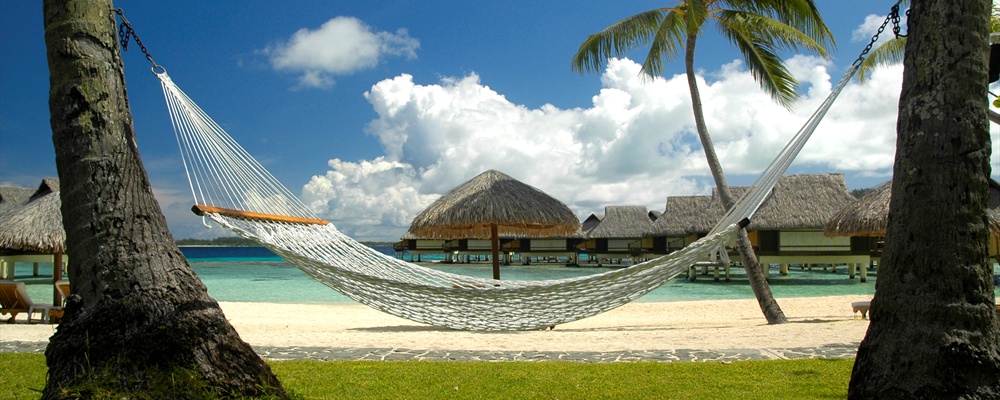
Today the Island of Bora Bora relies largely on tourism and because of this seven luxurious resorts were built over the past few years. Hotel Bora Bora was the first to build bungalows that stand over the water using stilts which are now a given of every resort on the island as these bungalows provide spectacular sites of lagoons and mountains.
Getting there
Air Tahiti flies several times a day from Tahiti. Flights are quite often full, so it is not a bad idea to make a reservation.
The airport is located on a small motu (islet) north of the main island. Transfer to the main island or to accommodations located on other motus is done by boat. The major accommodations have counters at the airport. For the accommodations located on the main island, you will need to take the (free) ferry to Vaitape. From there, small buses will usually pick you up.
Traveling around
Vaitape is the arrival point of the ferry from the airport, and is the only "town" of any size of the island. At the southern tip of the main island, Matira is the location of the largest beach as well as several hotels and restaurants. The central part of the island is extremely mountaineous, tough to access and not inhabited (and furthermore devoid of roads of any kind).
The way you get around in Bora Bora depends greatly on your accommodation and its location. Several resorts are actually located on motus and not on the main island, hence the need of boat transportation to get anywhere. Boat transfers from those motus resorts to the main island or between the resorts and the airport are usually provided. Accommodations located on the island generally also provide a transfer to and the Airport ferry quay.
On the main island, there is only one sealed road. Public transport on the island is limited, consisting of a single bus that goes halfway around the island and back approximately every hour. Taxis are also available.
Operators of activities and restaurants sometimes (but not always) provide a transfer to and from the accommodations - be sure to ask when booking.
Renting a bicycle or a small buggy can be an option if you plan to have your freedom on the main island, but the road is sometimes very narrow, and in bad shape.
See
The island of Bora Bora is actually a volcanic caldera. This geography has produced a lagoon, well protected from waters by the surrounding motus (islets). The lagoon, and the tropical underwater life, including sharks and rays, provide fantastic opportunities for many forms of water-based recreation, ranging from swimming, through snorkelling and to scuba and other options if you truly want to immerse yourself in this unique environment.
In addition to the sights under the surface of the lagoon, the dominating and unusually shaped peak of Mount Otemanu which reaches 728 metres above sea level, and its smaller neighbour Mount Pahia are also worthy attractions. The combination of the beautiful lagoon and these impressive peaks provide an almost endless supply of opportunities to take travel photos which will leave your friend back home cursing you for sharing them.
Very few go to Bora Bora for the historic relics. However, if you have seen enough of the lagoon, you might want to take a peek at the few WWII remains and the archeological polynesian relics in one of the tours of the island.
Bora Bora Lagoonarium, A certified diver acts as underwater guide as you swim and come face to face with the dolphins, turtles, sharks, sting rays and numerous other fish which call the lagoonaruim their home. For those that are not into diving, there is the Aquascope; a semi-submersible watercraft, designed by a very close friend of the world-renowned Jacques Cousteau. Numerous travelers that have voted this as an all time favorite.
Things to do
There are comparatively more activities in Bora Bora to keep you occupied than in other islands of French Polynesia.
Being practical while lazing under the sun in a white sand beach, a good book will be in every case a very useful item to bring. As weird as it may sound it actually sometimes rains in Bora Bora (and sometimes even a lot). The vast majority of the activities take place outdoor, and there are no cinemas, libraries or museums to visit, so even if large resorts do lend books and games, bring some good reading with you.
Water Activities
The tropical sea sometimes reaches 86F (30C), making it perfect for various water activities. Swimming in the lagoon in perfectly clear warm water has the advantage of being free and can be very enjoyable. The beaches of Bora Bora are not huge by any standards, nor are they crammed with people. The most famous beach, Matira Beach is at the southern tip of the main island.
You do not have to pay a lot to enjoy Bora Bora. Just like swimming, snorkeling is possible in many areas close to the shore, and even in Matira Beach you will be surrounded by multicolor tropical fish in seconds and in shallow waters.. Just remember to get out and put on sunscreen from time to time as the sun is strong and you will get burned badly if you stay in the water for an extended period of time.
Several companies operate snorkeling tours in the lagoon, bringing you by boat farther off the coast:
Shark & Ray Snorkel Safari, Shark and Ray feeding is typically done in shallow waters inside the lagoon. Approximately 10-20 sharks as well as 10-15 Rays will approach the boat and swim nearby, largely avoiding any snorkelers courageous enough to swim near.
Shark Boy, Book through Bora Bora Pearl Resort
Jourdain Tetuanui, 689 677 934, Offering many and varied services from water taxi to tours, fishing to feeding. Recommended by a WikiTravel use.
Windward Islands Yacht Charter, One of the worlds largest yacht charter companies, can take care of all charter requirements, from bareboat to luxury yacht in French Polynesia. Operating from different offices worldwide (UK, USA, Hong Kong, Dubai, Germany, Italy, France, Spain and Switzerland).
TopDive Scuba, Vaitape
Nemo World Scuba, Matira
Aquasafari, If you do not have a diving license, but still want to enjoy the underwater scenery, this is an option. You do not actually need to know how to swim in order to wear the breathing undersea apparatus, and children from 8 are accepted.
Jet ski tours around the interior island are well worth the effort as they allow to appreciate the scenery from various viewpoints, although they do inflict noise and pollution.
Kiteboarding is getting popular at the Southern tip of Matira.
Land activities
The island is about 20 miles around, and bikes and small buggys are available for rent at various sites. It is well worth the investment to ride the perimeter of the island.
You can do horseback riding along the motus on the fringe of Bora Bora as well as biking. Easiest to book through your hotel as they will know all the various activities that are available.
The Jeep tours are well worth a trip. You'll have a good time climbing through some rough trails on the island, and you'll get some breathtaking views. In addition, you'll tour the American WWII ruins, such as gun emplacements and bunkers.
It is possible to access the summit of Mt. Pahia by foot, although neither the staff at City Hall nor the Gendarmerie will tell you how if you do not have a guide, as even adept hikers have gotten lost or been injured. To access the trailhead, head 100 m (330 ft) north of the cross-street into Vaitape harbor. There will be an arcade of shops to your right. Look for a dirt road between the antique dealer and snack toward the north end of the arcade. Head up the dirt road about 150 m (465 ft) and look for a small grass field on your left that is just before the last house on the drive. It is wise to ask the owner for passage, as you must traverse privately-owned property to access the trail, which will initially appear faint but become more defined after the first 10 m (33 ft). Continue along the trail until you reach a fork, which will have two other trails heading north and south (through a plantation and an open field, respectively), and the main trail up to the top due east. Make sure you are well-provisioned, as the 600 m elevation gain takes place over a relatively short distance, and be sure to identify the trees or rocks with white-red-white striping that will show you the way. Some of the latter sections can be precarious, so make sure you keep your grip and be courteous to those who may be downstream of falling rocks unintentionally loosed by your foothold. The rope climb at the end is exciting! If you want more, head south along the uncommonly-traveled trail for iconic views.
Eat
Matira and surrounds
Bounty Snack, Very reasonably priced but excellent Tahitian restaurant.
Restaurant Patoti, Located on the mountain side close to Sofitel, A difficult to classify restaurant (expect a mix of typical French with a mix of tahitian influence).
Vaitape and surrounds
Bamboo House, Located about halfway between Vaitape and Hoteldive center, This restaurant's name refers only to the setting, not the cuisine. The Bamboo House serves upscale French Polynesian fare for reasonable prices.
Unknown location
Please update/move listings if you know
Bloody Mary's, There are not a lot of restaurants in Bora Bora, but this by far is the most famous. Some visitors might be a little surprised by the service (speed over quality...). Outside they have a pair of big boards with the names on all of the famous people who have eaten there, e.g. Pamela Anderson, Pierce Brosnan, Marlon Brando, and Janet Jackson.
Kaina Hut, An authentic polynesian restaurant with all tables set on a patio covered by a thatched-roof.
Villa Mahana, A small french restaurant with only 5 tables. Serves the best French food on the Island, by an amazing chef. Make reservations.
Sunset Boulevard, A new concept of restaurant where you can eat on boats, actually there is a little catamaran called the
Sleep
Bora Bora Islands offer numerous hospitality resources in which guests can stay.
Budget
It is possible to keep some money for the activities by staying in one of the family pensions or even in a camp.
Village Pauline, I'm told that Village Pauline has closed.
Chez Henriette
Mid-Range
Novotel Bora Bora Beach Resort, An oddity in Bora Bora : this hotel has affordable rooms, with an overall excellent service and a very good location. There are no overwater bungalows there, only tranquil garden view rooms, and the beach is less than 10 meters away.
Manureva House
Splurge
Keep in mind that the establishments listed below have prices above several hundred USD per night (the average being somewhere just above 1000), with suites well above several thousand dollars a night.
Bora Bora Lagoon Resort & Spa, 77 over-water bungalows, swimming pool, fitness centre and tennis courts. A member of Orient-Express hotels.
Hotel Bora Bora, Small, exclusive hotel with over-water bungalows on the best location on the island. It is the place that started the trend of bungalows over the water in the 60s. Closed for total reconstruction until 2011.
Bora Bora Pearl Beach Resort and Spa, Located off the main island, on the island motu Tevairoa, 50 over-water bungalows, and 30 more beach and garden bungalows. In order to get to the main island, regular boat shuttles take guests from the hotel's dock to a dock in Faanui, on the main island's north western end.
Maitai, Matira, Features (comparatively) reasonably priced over-water bungalows, not as splendid as its neighbor the Intercontinental, but nice. Get one of the over-water rooms at the end of the pier in which the rooms are located on as the water is deeper at these rooms. The other rooms are just off the beach and some are in water less than 1 ft. deep.
Club Mediterranee Bora Bora, Relatively well located, it is nonetheless a bit less extravantly luxuous than its competitors, and probably a bit expensive for what it is.
Sofitel Bora Bora Beach Resort, Matira, Luxuous yet intimate hotel with over-water bungalows and an incredible pool facing the sea.
Sofitel Motu Bora Bora (Note: different from the Beach Resort), On the Motu facing Matira, Enjoys fantastic views of the island, and has incredible snorkeling (snorkeling tour boats actually come to the area). The beach is a bit small, but the whole place is much more intimate than other motu-located resorts.
Intercontinental Le Moana Bora Bora, At the very tip of Matira on the main island, You do not get the views on the island (well, you're ON it), nonethess this is a classy luxury resort with all you can expect for the price you pay.
Le Meridien Bora Bora, Large hotel, billing itself as a 5 star resort. Very expensive, and the staff was less than hospitable. A popular destination for Japanese weddings, this hotel features a pretty cool turtle sanctuary and has a ton of beach. The overwater bungalows are a novelty. It sits on a motu away from the main island, travel to the main island is via shuttle boat.
St. Regis Bora Bora, Newest and highest-priced resort on Bora Bora. Every room (100 in all) is a suite with luxury bathroom. Many of the rooms are over-water villas, some with pools or spas. Overwater villas have glass panels in the floors and under-villa lighing to make the lagoon shimmer in your room. Guests are 80% American, 80% of whom are honeymooners. Nicole Kidman and Keith Urban honeymooned here. Two excellent restaurants on-site, one by Chef Jean Georges. The angle of the view on the main island is impressive.
Buy
Taking into account the costs of everything in Bora Bora, which sometimes defy imagination, it is a perfectly sound choice to forget the common sense of the traveller and buy as much as possible (including groceries) before getting there. Keep that option in mind if you want to self cater.
In case you do need something while on the island, you can find a medium-sized general groceries store in Vaitape (called Chin Lee) with a reasonable choice of food and drinks. A smaller grocery store near Matira beach can be helpful if you stay in the area and you do not want to get back to Vaitape, but the choice is much more limited.
The "specialty" of Bora Bora is Black Pearls.
Get out
Maupiti, located 40 km from Bora Bora, is a smaller and less touristic but equally charming volcanic island. It can be reached by the Maupiti Express , an express ferry riding 3 times a week from Vaitape.
Contact & location
Be the first one to add a review
The photos displayed on this page are the property of one of the following authors:
Some photos courtesy of:
, . The photos provided by Flickr, Panoramio are under the copyright of their owners.
This travel guide also includes text from Wikitravel articles, all available at View full credits
Peter Fitzgerald, Luke Stevenson, Stefan Ertmann, Kai Kranz, David, Chris Bosken, Todd VerBeek, subdigit and Ricardo, Eunesther.choi, Inas, Episteme, Morph and Tensaibuta
This travel guide also includes text from Wikipedia articles, all available at View full credits








Bora Bora is a volcanic island in the Society Islands archipelago of French Polynesia.
It is perfectly possible to spoil oneself in one of the incredibly luxurious high-class resorts and spend the savings of a lifetime in a few days. Nonetheless, a bit of planning ahead can allow enjoyment of the majestic scenery with a tighter budget. Keep in mind that in any case Bora Bora is a tremendously pricey destination. Everything (catering and activities) ranges from "expensive" to "indescribably expensive".
Bora Bora is an island in the Leeward group of the Society Islands of French Polynesia, an overseas collectivity of France in the Pacific Ocean. The island, located about 230 kilometres (140 mi) northwest of Papeete, is surrounded by a lagoon and a barrier reef. In the center of the island are the remnants of an extinct volcano rising to two peaks, Mount Pahia and Mount Otemanu, the highest point at 727 metres (2,385 ft). The original name of the island in the Tahitian language might be better rendered as Pora Pora, meaning "First Born"; an early transcription found in 18th- and 19th century accounts, is Bolabolla or Bollabolla.
The major settlement, Vaitape is on the western side of the island, opposite the main channel into the lagoon. The products of the island are mostly limited to what can be obtained from the sea and coconut trees, which were historically of economic importance for copra. During the August 2007 census, the population on the island was about 8,880 people.
Understand
The main languages that are spoken by people in Bora Bora Island are French and Tahitian although most inhabitants that inter-act with visitors have good comprehension of the English language. Most tourists that visit the island are Americans, Japanese and Europeans.
History
The history of Bora Bora shows that the island’s first settlers back in the 4th century were Tongan people. The first European explorers who visited the island were led by James Cook. However, prior to this island of Bora Bora was already sighted by other explorers. The history of Bora Bora also indicates that in 1842 the island became a colony of France under the leadership of Admiral Abel Aubert Dupetit Thouars.
During World War II, the United States picked Bora Bora as a base for military supply, oil depot, air strip and seaplane base. They also constructed defensive fortifications around the island. Luckily though, no combat took place here and the presence of American troops seemed to be accepted by the opposition forces.
According to the history of Bora Bora, the United States Military Base officially closed on June 2, 1946 following the end of the war. However, many Americans refused to leave the island as it had become close to their hearts. Some Americans were even forcibly asked to leave following complaints from their families on the mainland. The abandoned base became French Polynesia’s only international airport until Faa'a International Airport opened in the 1962 in Papeete, Tahiti.
Today the Island of Bora Bora relies largely on tourism and because of this seven luxurious resorts were built over the past few years. Hotel Bora Bora was the first to build bungalows that stand over the water using stilts which are now a given of every resort on the island as these bungalows provide spectacular sites of lagoons and mountains.
Getting there
Air Tahiti flies several times a day from Tahiti. Flights are quite often full, so it is not a bad idea to make a reservation.
The airport is located on a small motu (islet) north of the main island. Transfer to the main island or to accommodations located on other motus is done by boat. The major accommodations have counters at the airport. For the accommodations located on the main island, you will need to take the (free) ferry to Vaitape. From there, small buses will usually pick you up.
Traveling around
Vaitape is the arrival point of the ferry from the airport, and is the only "town" of any size of the island. At the southern tip of the main island, Matira is the location of the largest beach as well as several hotels and restaurants. The central part of the island is extremely mountaineous, tough to access and not inhabited (and furthermore devoid of roads of any kind).
The way you get around in Bora Bora depends greatly on your accommodation and its location. Several resorts are actually located on motus and not on the main island, hence the need of boat transportation to get anywhere. Boat transfers from those motus resorts to the main island or between the resorts and the airport are usually provided. Accommodations located on the island generally also provide a transfer to and the Airport ferry quay.
On the main island, there is only one sealed road. Public transport on the island is limited, consisting of a single bus that goes halfway around the island and back approximately every hour. Taxis are also available.
Operators of activities and restaurants sometimes (but not always) provide a transfer to and from the accommodations - be sure to ask when booking.
Renting a bicycle or a small buggy can be an option if you plan to have your freedom on the main island, but the road is sometimes very narrow, and in bad shape.
See
The island of Bora Bora is actually a volcanic caldera. This geography has produced a lagoon, well protected from waters by the surrounding motus (islets). The lagoon, and the tropical underwater life, including sharks and rays, provide fantastic opportunities for many forms of water-based recreation, ranging from swimming, through snorkelling and to scuba and other options if you truly want to immerse yourself in this unique environment.
In addition to the sights under the surface of the lagoon, the dominating and unusually shaped peak of Mount Otemanu which reaches 728 metres above sea level, and its smaller neighbour Mount Pahia are also worthy attractions. The combination of the beautiful lagoon and these impressive peaks provide an almost endless supply of opportunities to take travel photos which will leave your friend back home cursing you for sharing them.
Very few go to Bora Bora for the historic relics. However, if you have seen enough of the lagoon, you might want to take a peek at the few WWII remains and the archeological polynesian relics in one of the tours of the island.
Things to do
There are comparatively more activities in Bora Bora to keep you occupied than in other islands of French Polynesia. Being practical while lazing under the sun in a white sand beach, a good book will be in every case a very useful item to bring. As weird as it may sound it actually sometimes rains in Bora Bora (and sometimes even a lot). The vast majority of the activities take place outdoor, and there are no cinemas, libraries or museums to visit, so even if large resorts do lend books and games, bring some good reading with you.
Water Activities
The tropical sea sometimes reaches 86F (30C), making it perfect for various water activities. Swimming in the lagoon in perfectly clear warm water has the advantage of being free and can be very enjoyable. The beaches of Bora Bora are not huge by any standards, nor are they crammed with people. The most famous beach, Matira Beach is at the southern tip of the main island.
You do not have to pay a lot to enjoy Bora Bora. Just like swimming, snorkeling is possible in many areas close to the shore, and even in Matira Beach you will be surrounded by multicolor tropical fish in seconds and in shallow waters.. Just remember to get out and put on sunscreen from time to time as the sun is strong and you will get burned badly if you stay in the water for an extended period of time.
Several companies operate snorkeling tours in the lagoon, bringing you by boat farther off the coast:
Shark & Ray Snorkel Safari, Shark and Ray feeding is typically done in shallow waters inside the lagoon. Approximately 10-20 sharks as well as 10-15 Rays will approach the boat and swim nearby, largely avoiding any snorkelers courageous enough to swim near.
Shark Boy, Book through Bora Bora Pearl Resort
Jourdain Tetuanui, 689 677 934, Offering many and varied services from water taxi to tours, fishing to feeding. Recommended by a WikiTravel use.
Windward Islands Yacht Charter , One of the worlds largest yacht charter companies, can take care of all charter requirements, from bareboat to luxury yacht in French Polynesia. Operating from different offices worldwide (UK, USA, Hong Kong, Dubai, Germany, Italy, France, Spain and Switzerland).
TopDive Scuba , Vaitape
Nemo World Scuba , Matira
Aquasafari , If you do not have a diving license, but still want to enjoy the underwater scenery, this is an option. You do not actually need to know how to swim in order to wear the breathing undersea apparatus, and children from 8 are accepted.
Jet ski tours around the interior island are well worth the effort as they allow to appreciate the scenery from various viewpoints, although they do inflict noise and pollution.
Kiteboarding is getting popular at the Southern tip of Matira.
Land activities
The island is about 20 miles around, and bikes and small buggys are available for rent at various sites. It is well worth the investment to ride the perimeter of the island.
You can do horseback riding along the motus on the fringe of Bora Bora as well as biking. Easiest to book through your hotel as they will know all the various activities that are available.
The Jeep tours are well worth a trip. You'll have a good time climbing through some rough trails on the island, and you'll get some breathtaking views. In addition, you'll tour the American WWII ruins, such as gun emplacements and bunkers.
It is possible to access the summit of Mt. Pahia by foot, although neither the staff at City Hall nor the Gendarmerie will tell you how if you do not have a guide, as even adept hikers have gotten lost or been injured. To access the trailhead, head 100 m (330 ft) north of the cross-street into Vaitape harbor. There will be an arcade of shops to your right. Look for a dirt road between the antique dealer and snack toward the north end of the arcade. Head up the dirt road about 150 m (465 ft) and look for a small grass field on your left that is just before the last house on the drive. It is wise to ask the owner for passage, as you must traverse privately-owned property to access the trail, which will initially appear faint but become more defined after the first 10 m (33 ft). Continue along the trail until you reach a fork, which will have two other trails heading north and south (through a plantation and an open field, respectively), and the main trail up to the top due east. Make sure you are well-provisioned, as the 600 m elevation gain takes place over a relatively short distance, and be sure to identify the trees or rocks with white-red-white striping that will show you the way. Some of the latter sections can be precarious, so make sure you keep your grip and be courteous to those who may be downstream of falling rocks unintentionally loosed by your foothold. The rope climb at the end is exciting! If you want more, head south along the uncommonly-traveled trail for iconic views.
Eat
Matira and surrounds
Bounty Snack, Very reasonably priced but excellent Tahitian restaurant.
Restaurant Patoti, Located on the mountain side close to Sofitel, A difficult to classify restaurant (expect a mix of typical French with a mix of tahitian influence).
Vaitape and surrounds
Unknown location
Please update/move listings if you know
Bloody Mary's, There are not a lot of restaurants in Bora Bora, but this by far is the most famous. Some visitors might be a little surprised by the service (speed over quality...). Outside they have a pair of big boards with the names on all of the famous people who have eaten there, e.g. Pamela Anderson, Pierce Brosnan, Marlon Brando, and Janet Jackson.
Kaina Hut, An authentic polynesian restaurant with all tables set on a patio covered by a thatched-roof.
Villa Mahana, A small french restaurant with only 5 tables. Serves the best French food on the Island, by an amazing chef. Make reservations.
Sunset Boulevard , A new concept of restaurant where you can eat on boats, actually there is a little catamaran called the
Sleep
Bora Bora Islands offer numerous hospitality resources in which guests can stay.
Budget
It is possible to keep some money for the activities by staying in one of the family pensions or even in a camp.
Village Pauline, I'm told that Village Pauline has closed.
Chez Henriette
Mid-Range
Novotel Bora Bora Beach Resort, An oddity in Bora Bora : this hotel has affordable rooms, with an overall excellent service and a very good location. There are no overwater bungalows there, only tranquil garden view rooms, and the beach is less than 10 meters away.
Manureva House
Splurge
Keep in mind that the establishments listed below have prices above several hundred USD per night (the average being somewhere just above 1000), with suites well above several thousand dollars a night.
Bora Bora Lagoon Resort & Spa , 77 over-water bungalows, swimming pool, fitness centre and tennis courts. A member of Orient-Express hotels.
Hotel Bora Bora, Small, exclusive hotel with over-water bungalows on the best location on the island. It is the place that started the trend of bungalows over the water in the 60s. Closed for total reconstruction until 2011.
Bora Bora Pearl Beach Resort and Spa , Located off the main island, on the island motu Tevairoa, 50 over-water bungalows, and 30 more beach and garden bungalows. In order to get to the main island, regular boat shuttles take guests from the hotel's dock to a dock in Faanui, on the main island's north western end.
Maitai , Matira, Features (comparatively) reasonably priced over-water bungalows, not as splendid as its neighbor the Intercontinental, but nice. Get one of the over-water rooms at the end of the pier in which the rooms are located on as the water is deeper at these rooms. The other rooms are just off the beach and some are in water less than 1 ft. deep.
Club Mediterranee Bora Bora, Relatively well located, it is nonetheless a bit less extravantly luxuous than its competitors, and probably a bit expensive for what it is.
Sofitel Bora Bora Beach Resort, Matira, Luxuous yet intimate hotel with over-water bungalows and an incredible pool facing the sea.
Sofitel Motu Bora Bora (Note: different from the Beach Resort), On the Motu facing Matira, Enjoys fantastic views of the island, and has incredible snorkeling (snorkeling tour boats actually come to the area). The beach is a bit small, but the whole place is much more intimate than other motu-located resorts.
Intercontinental Le Moana Bora Bora , At the very tip of Matira on the main island, You do not get the views on the island (well, you're ON it), nonethess this is a classy luxury resort with all you can expect for the price you pay.
Le Meridien Bora Bora, Large hotel, billing itself as a 5 star resort. Very expensive, and the staff was less than hospitable. A popular destination for Japanese weddings, this hotel features a pretty cool turtle sanctuary and has a ton of beach. The overwater bungalows are a novelty. It sits on a motu away from the main island, travel to the main island is via shuttle boat.
St. Regis Bora Bora , Newest and highest-priced resort on Bora Bora. Every room (100 in all) is a suite with luxury bathroom. Many of the rooms are over-water villas, some with pools or spas. Overwater villas have glass panels in the floors and under-villa lighing to make the lagoon shimmer in your room. Guests are 80% American, 80% of whom are honeymooners. Nicole Kidman and Keith Urban honeymooned here. Two excellent restaurants on-site, one by Chef Jean Georges. The angle of the view on the main island is impressive.
Buy
Taking into account the costs of everything in Bora Bora, which sometimes defy imagination, it is a perfectly sound choice to forget the common sense of the traveller and buy as much as possible (including groceries) before getting there. Keep that option in mind if you want to self cater.
In case you do need something while on the island, you can find a medium-sized general groceries store in Vaitape (called Chin Lee) with a reasonable choice of food and drinks. A smaller grocery store near Matira beach can be helpful if you stay in the area and you do not want to get back to Vaitape, but the choice is much more limited.
The "specialty" of Bora Bora is Black Pearls.
Get out
Maupiti, located 40 km from Bora Bora, is a smaller and less touristic but equally charming volcanic island. It can be reached by the Maupiti Express , an express ferry riding 3 times a week from Vaitape.
Contact & location
Be the first one to add a review
The photos displayed on this page are the property of one of the following authors:
mcclave, rachel_thecat, clesenne, tensaibuta, tiarescott, Duncan Rawlinson, heavenearth, brendnpeto
Some photos courtesy of: ,
,  . The photos provided by Flickr, Panoramio are under the copyright of their owners.
This travel guide also includes text from Wikitravel articles, all available at View full credits
Peter Fitzgerald, Luke Stevenson, Stefan Ertmann, Kai Kranz, David, Chris Bosken, Todd VerBeek, subdigit and Ricardo, Eunesther.choi, Inas, Episteme, Morph and Tensaibuta
This travel guide also includes text from Wikipedia articles, all available at View full credits